How Thai Interpreters Bridge Language Gaps
In an era marked by globalization, effective cross-cultural communication has become pivotal. Interpretation serves as a fundamental component in overcoming language barriers, allowing people from different linguistic backgrounds to communicate effectively. While translation deals with written text, interpretation focuses on spoken or signed communication, often in real-time. This aspect of language services is essential in numerous settings, including international business, diplomacy, healthcare, and legal proceedings. Among these interpreters, Thai interpreters distinguish themselves with their capability to navigate the unique linguistic intricacies and cultural contexts of the Thai language.
The Role and Skills of Thai Interpreters

Thai interpreters hold a significant role in bridging communication gaps across diverse industries. Their work requires not just linguistic proficiency but also a profound understanding of Thai culture to accurately convey both meaning and intent. Misinterpretations can lead to severe misunderstandings, especially in sensitive areas such as legal interpretation and medical contexts.
Core Skills of a Thai Interpreter:
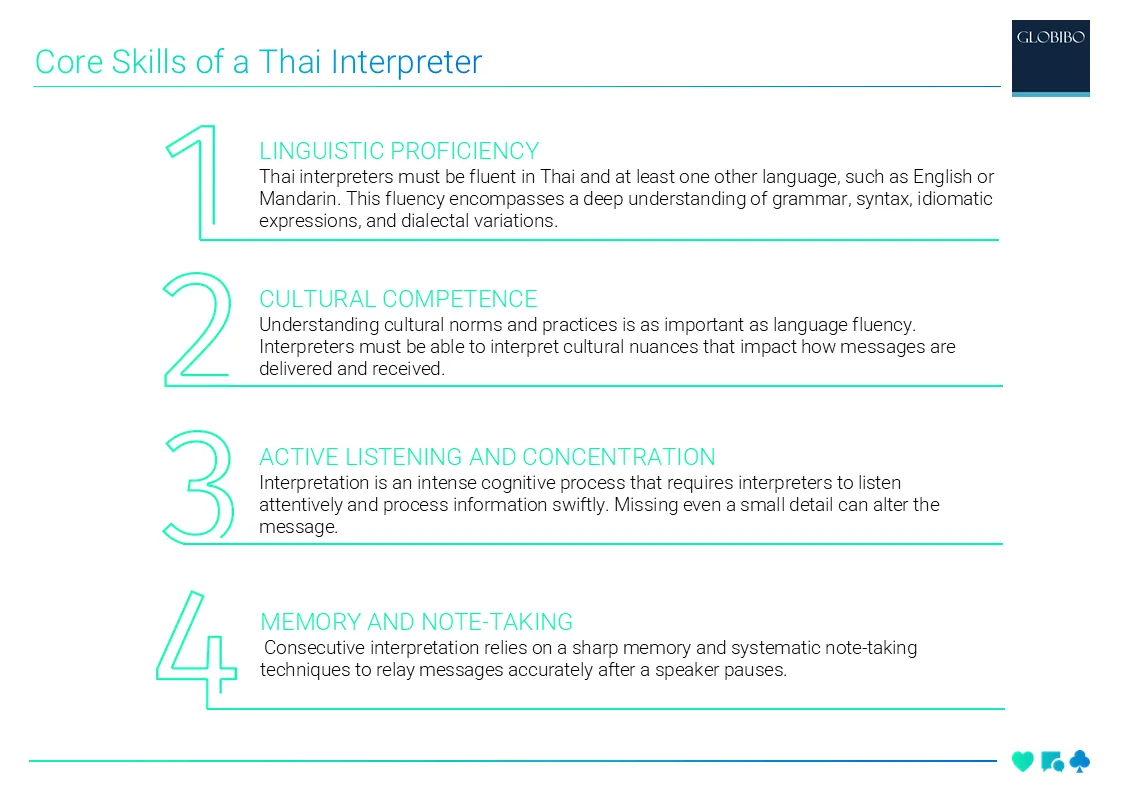
- Linguistic Proficiency: Thai interpreters must be fluent in Thai and at least one other language, such as English or Mandarin. This fluency encompasses a deep understanding of grammar, syntax, idiomatic expressions, and dialectal variations.
- Cultural Competence: Understanding cultural norms and practices is as important as language fluency. Interpreters must be able to interpret cultural nuances that impact how messages are delivered and received.
- Active Listening and Concentration: Interpretation is an intense cognitive process that requires interpreters to listen attentively and process information swiftly. Missing even a small detail can alter the message.
- Memory and Note-Taking: Consecutive interpretation relies on a sharp memory and systematic note-taking techniques to relay messages accurately after a speaker pauses.
- Interpersonal and Communication Skills: Building rapport and maintaining clear communication are essential for interpreters to create trust and facilitate smoother interactions.
Click here to learn about Choosing the Right Thai Interpreter and The Impact of Thai Interpreters in Legal Settings.
Types of Interpretation Services Provided by Thai Interpreters

Thai interpreters adapt to different modes of interpretation based on the needs of the situation. Each mode requires a unique set of skills and tools, depending on the complexity, size, and formality of the event.
1. Simultaneous Interpretation
Simultaneous interpretation involves interpreting the spoken language in real-time as the speaker continues without pausing. This type of interpretation is commonly used in large-scale conferences, international summits, and events where multilingual communication is required. Thai interpreters often work from soundproof booths equipped with headsets and microphones, ensuring they can hear the speaker clearly while delivering the interpretation without disruption.
Key Features:
- Real-time communication, maintaining the flow of dialogue.
- Requires high concentration and multitasking skills.
- Typically involves a team of interpreters to rotate every 20-30 minutes due to cognitive demands.
2. Consecutive Interpretation
Consecutive interpretation is suitable for smaller meetings, interviews, and legal proceedings. The interpreter listens to a segment of speech and waits for the speaker to pause before delivering the interpretation. This method allows for a more detailed and accurate rendition of the message.
Advantages:
- Greater accuracy as the interpreter has more time to process information.
- Suitable for scenarios that require detailed information transmission.
Challenges:
- Takes longer, potentially affecting the meeting’s flow.
- The speaker must pause regularly, requiring coordination.
3. Whispered Interpretation (Chuchotage)
This type of interpretation is used in situations where only one or a few participants require interpretation. The interpreter sits or stands close to the client and whispers the interpretation in real-time. This mode is ideal for small groups or individual needs, such as business meetings or diplomatic discussions.
Benefits:
- Ensures minimal disruption to the event.
- Allows quick and private communication.
Limitations:
- Only suitable for a limited number of listeners.
- Can be physically demanding due to the need for the interpreter to speak quietly for extended periods.
4. Liaison or Escort Interpretation
Liaison interpretation involves interpreters accompanying clients during trips, business visits, or informal gatherings. Thai interpreters in this role facilitate conversations in real-time to ensure seamless interaction across various settings.
Use Cases:
- Business negotiations.
- Guided tours and site visits.
- Informal social events.
5. Remote Interpretation
Remote Thai interpretation has gained traction with advancements in technology and the increasing demand for flexible language services. This method uses video or telecommunication platforms to provide interpretation services remotely, allowing clients to access skilled interpreters without geographical constraints.
Technological Requirements:
- Stable internet connection.
- Reliable video conferencing platforms.
- High-quality audio equipment.
Pros and Cons:
- Pros: Flexibility, convenience, immediate access.
- Cons: Dependence on technology, potential technical glitches.
Benefits of Utilizing Professional Thai Interpreters
| Benefit | Description |
| Enhanced Communication | Ensures accurate conveyance of messages, fostering trust and reducing misunderstandings. |
| Cultural Sensitivity | Helps navigate complex cultural norms and expectations, preserving the context and nuances of messages. |
| Efficiency in Business | Streamlines negotiations and enhances the success of international partnerships. |
| Compliance and Accuracy | Essential in legal and medical settings to avoid potential liabilities and ensure accurate representation. |
| Accessibility | Facilitates communication for clients in remote or virtual settings, making language services more inclusive. |
Challenges Faced by Thai Interpreters
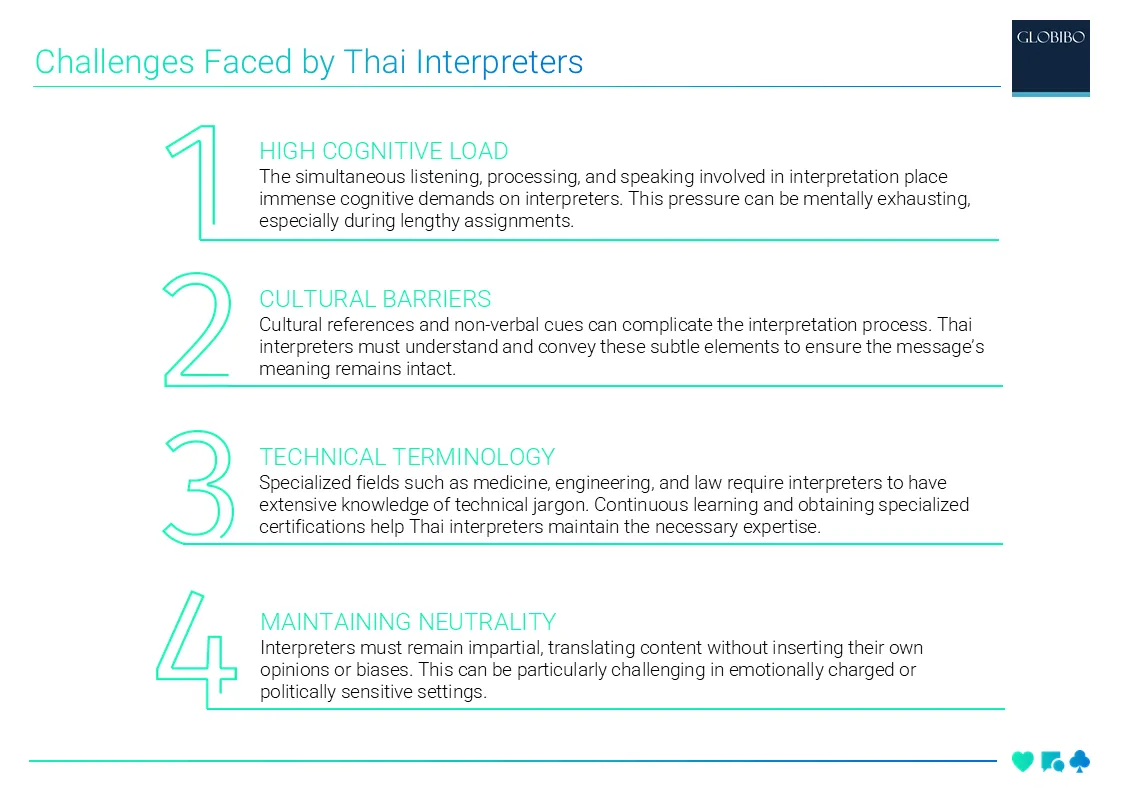
Interpreters face several challenges that test their skills and adaptability. These challenges often require ongoing education and practice to manage effectively.
- High Cognitive Load: The simultaneous listening, processing, and speaking involved in interpretation place immense cognitive demands on interpreters. This pressure can be mentally exhausting, especially during lengthy assignments.
- Cultural Barriers: Cultural references and non-verbal cues can complicate the interpretation process. Thai interpreters must understand and convey these subtle elements to ensure the message’s meaning remains intact.
- Technical Terminology: Specialized fields such as medicine, engineering, and law require interpreters to have extensive knowledge of technical jargon. Continuous learning and obtaining specialized certifications help Thai interpreters maintain the necessary expertise.
- Maintaining Neutrality: Interpreters must remain impartial, translating content without inserting their own opinions or biases. This can be particularly challenging in emotionally charged or politically sensitive settings.
- Rapid Adaptation: The ability to quickly adapt to changing topics or unexpected events is essential for interpreters. This adaptability ensures they can continue providing accurate services even when discussions take an unanticipated turn.
Click here to learn about How Thai Medical Interpreters Bridge Healthcare Communication Gap.
Key Challenges and Solutions for Thai Interpreters
| Challenge | Solution |
| High Cognitive Demand | Regular mental exercises and training to enhance memory and multitasking abilities. |
| Complex Cultural References | Continuous cultural education and immersion to keep updated with cultural shifts and nuances. |
| Technical Jargon | Ongoing professional development and certification in specialized fields (e.g., medical terms). |
| Maintaining Neutrality | Adhering to professional ethics and guidelines set by interpretation associations. |
| Adaptability in New Environments | Practice with diverse topics and role-playing various scenarios to build flexibility. |
Best Practices for Thai Interpreters
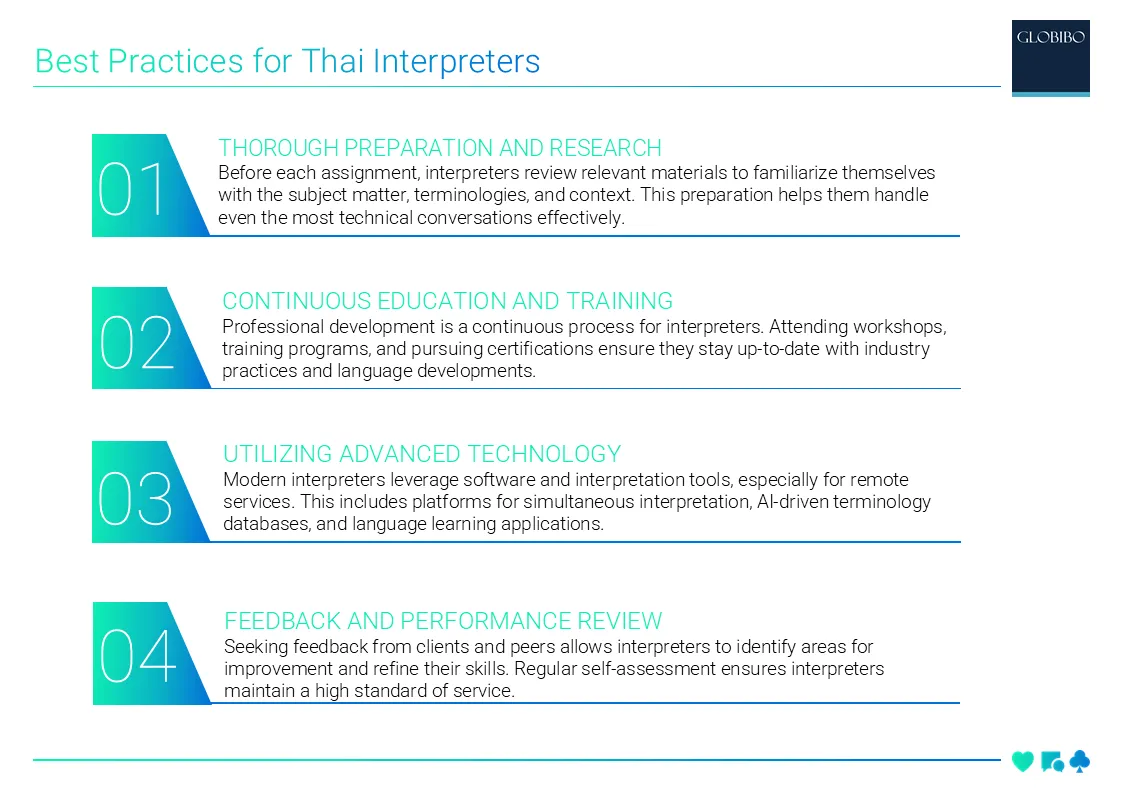
Achieving excellence in interpretation requires more than just linguistic skills. Thai interpreters adopt a set of best practices to maintain high-quality services:
- Thorough Preparation and Research: Before each assignment, interpreters review relevant materials to familiarize themselves with the subject matter, terminologies, and context. This preparation helps them handle even the most technical conversations effectively.
- Continuous Education and Training: Professional development is a continuous process for interpreters. Attending workshops, training programs, and pursuing certifications ensure they stay up-to-date with industry practices and language developments.
- Building a Professional Network: Collaborating with other interpreters, both locally and internationally, provides opportunities to share knowledge, discuss challenges, and gain new perspectives.
- Utilizing Advanced Technology: Modern interpreters leverage software and interpretation tools, especially for remote services. This includes platforms for simultaneous interpretation, AI-driven terminology databases, and language learning applications.
- Feedback and Performance Review: Seeking feedback from clients and peers allows interpreters to identify areas for improvement and refine their skills. Regular self-assessment ensures interpreters maintain a high standard of service.
The Impact of Thai Interpreters in Global Business
Thai interpreters are essential to fostering international relations and business success. Their ability to convey messages accurately and with cultural sensitivity ensures that companies can operate smoothly within the Thai market and collaborate effectively with Thai partners.
Case Study Example: Consider an international company planning to partner with a Thai manufacturing firm. During negotiations, complex discussions around compliance, standards, and contracts took place. The presence of a skilled Thai interpreter enabled clear communication, bridging linguistic and cultural differences and ensuring that all parties understood each aspect of the agreement. This case exemplifies how professional Thai interpreters contribute to positive business outcomes by preventing misunderstandings that could jeopardize contracts and relationships.
Comparison of Interpretation Modes for Thai Interpreters
| Interpretation Mode | Best Used For | Advantages | Limitations |
| Simultaneous | Conferences, large events | Fast, real-time translation | Requires specialized equipment, high skill level |
| Consecutive | Legal proceedings, small meetings | More detailed and accurate | Takes more time, potential loss of flow |
| Whispered (Chuchotage) | One-on-one or small groups | Minimal disruption | Only suitable for few listeners |
| Liaison/Escort | Business travel, informal interactions | Personal and adaptable | Limited to face-to-face settings |
| Remote | Virtual conferences, flexible needs | Convenient, accessible | Dependent on stable technology |
Summary of Thai Interpreters
Thai interpreters play an essential role in connecting linguistic and cultural divides, facilitating seamless communication in an increasingly globalized world. Their services support a range of critical areas, from business to diplomacy and public service. With a commitment to ongoing learning, cultural awareness, and adaptive practices, Thai interpreters continue to contribute to the success and understanding between diverse communities. Their work highlights the importance of professional interpretation in promoting mutual respect, clear dialogue, and productive relationships across languages and cultures.

Susan has extensive experience in conference interpretation, simultaneous interpretation, and Consecutive Interpretation services, document localization for governmental and legal needs. Her work with embassies and government agencies ensures that documents meet specific regional requirements, making her expertise invaluable for international clients.
Academic References for Thai Interpreters
- Navigating between systems and opening doors of opportunities: Thai‒English interpreters‘ experiences
- ‘I’ll Find It… Or I’ll Look It up…?’: Decoding Thai EFL Students’ Translation Errors in the Thai-English Language Pair in Multi-Linguacultural Higher Education.
- [PDF] Medical interpreters‘ knowledge and communication skills for effective teamwork with doctors and nurses: based on a study of Japanese-Thai interpreters at …
- Language and Community-Based Tourism in Thailand: Use, Needs, Dependency, and Limitations
- Languages, identities and education in Thailand
- Teaching EFL in Thailand: A bilingual study
- [PDF] A state of the art of Thai language resources and Thai language behavior analysis and modeling
- A Diachronic Assessment of Healthcare Interpreting: The Western Cape, SA as a Case in Point
- [PDF] Relief operations across language barriers: the interpreter factor
- It’s not rocket science: Interpreting figurative language in narratives