


Whispered Interpreter
Bridging Language Barriers with Subtle Expertise
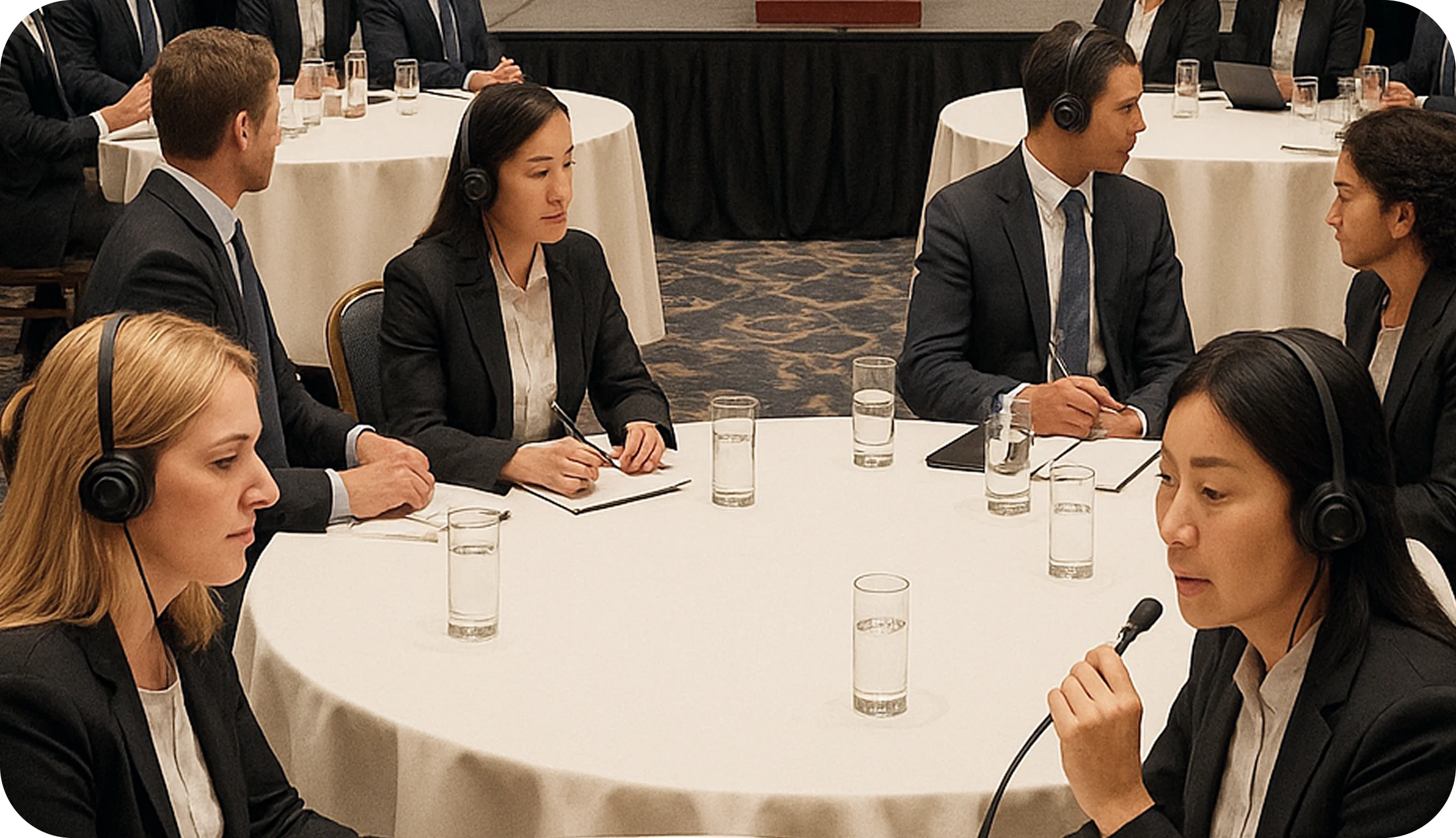

Whispered Interpretation Solution
Whispered interpreting is a form of simultaneous interpreting in which the interpreter speaks very quietly while remaining close to the listeners. ISO terminology identifies whispered interpreting as a simultaneous mode intended for a very small number of listeners, ideally one or two.
The format can be useful when most participants understand the presentation or discussion in the source language but a small number require interpretation. It can therefore avoid deploying a full interpretation infrastructure when the communication requirement is limited to a small group.
Typical applications include business meetings, executive discussions, site visits, factory tours, diplomatic or institutional interactions, small delegations, inspections, and selected event sessions.
Interpreter Selection
Interpreter selection should consider the language combination, subject matter, communication environment, assignment duration, participant profile, and required direction of interpretation.
Because the interpreter works close to the listeners and simultaneously processes the speaker’s communication, the assignment requires strong listening, concentration, language proficiency, and controlled delivery.
Specialized assignments may require interpreters familiar with industry-specific terminology. Medical, legal, technical, financial, and government communication should be planned with appropriate subject-matter requirements.
Listener Planning
The number and position of listeners are important because whispered interpretation is designed for a very small audience.
Before the assignment, the organizer should identify:
- Number of listeners requiring interpretation
- Source and target languages
- Listener positions
- Speaker location
- Room configuration
- Expected movement between locations
- Assignment duration
- Subject matter
- Audio conditions
- Whether other participants need access to the interpreted language
When the listener group becomes larger, equipment-assisted interpretation may provide better audio consistency and reduce disruption to the speaker and other participants.
Assignment Preparation
Preparation can include agendas, presentations, terminology lists, participant information, technical documents, product information, or other materials relevant to the assignment.
The interpreter can use these materials to prepare terminology and understand the communication context before the session.
Whispered interpretation should also be planned around room acoustics and participant positioning. The interpreter needs to hear the speaker clearly while delivering the interpretation quietly enough to avoid unnecessarily disturbing other participants.
This section Includes:











Role
01
A whispered interpreter can perform several functions during an assignment:
- Language Interpreter: Transfers spoken content from the source language into the target language.
- Listener Support: Provides direct language access to the small group requiring interpretation.
- Communication Facilitator: Helps listeners follow the speaker without interrupting the main communication flow.
- Terminology Manager: Applies appropriate terminology for the subject matter.
- Context Monitor: Maintains awareness of the speaker, setting, participants, and communication purpose.
- Positioning Manager: Maintains a practical position close enough for listeners to hear the interpretation.
- Quality Monitor: Continuously monitors comprehension, delivery, and environmental conditions.
Whispered Interpreter

Skill
02
Whispered interpreting requires a combination of linguistic and simultaneous-interpreting skills:
- Language Proficiency: Strong command of the working languages.
- Listening: Rapid comprehension of spoken source-language content.
- Processing: Ability to understand and reformulate information while the speaker continues.
- Concentration: Sustained attention during continuous speech.
- Voice Control: Ability to speak quietly while maintaining intelligibility.
- Memory: Retention of short segments while processing the next part of the speech.
- Terminology: Accurate use of subject-specific vocabulary.
- Adaptability: Ability to respond to changing topics and speaking speeds.
- Positioning: Ability to maintain an appropriate working position.
- Self-monitoring: Continuous control of accuracy, completeness, and delivery.
Whispered Interpreter

Challenges
03
Whispered interpreting comes with its own set of challenges:
Physical Strain: Since whispered interpreters do not use equipment, they may experience vocal fatigue and strain over extended periods.
Privacy Concerns: In some situations, chuchotage may not be suitable due to privacy concerns or if the whispered interpreter’s voice may disturb other participants.
Limited Capacity: Whispered interpreting is best suited for small groups; it may not be efficient for larger gatherings or events with multiple language combinations.
Click here to learn about Essentials of Whispered Interpretation
Whispered Interpreter

Benefits
04
Whispered interpretation can provide several operational benefits when the audience requiring interpretation is very small:
- Minimal Infrastructure: It can be delivered without a conventional interpretation booth in suitable environments.
- Small-group Access: Provides simultaneous interpretation to a limited number of listeners.
- Discreet Delivery: The interpreter’s output can remain localized to the listener group.
- Continuous Communication: Listeners receive interpretation while the speaker continues.
- Flexible Deployment: The interpreter can accompany participants in appropriate environments.
- Reduced Equipment Requirement: A conventional receiver distribution system may not be necessary for very small groups.
- Direct Participation: Listeners can remain involved in the main discussion without waiting for consecutive interpretation.
Whispered Interpreter

Impact
05
The primary communication impact is providing immediate access to spoken information for participants who do not understand the source language while allowing the original discussion to continue.
Whispered interpreting is particularly useful when only a very small number of participants require language support. ISO terminology specifically identifies the mode as appropriate for very small numbers of listeners, ideally one or two.
The communication environment remains important. Excessive background noise, large listener groups, long distances, or poor room acoustics can reduce the suitability of whispered delivery and may justify an equipment-assisted alternative.
Whispered Interpreter
Interpretation Delivery
Whispered interpretation is primarily an in-person simultaneous mode, but related interpretation configurations can be considered when the number of listeners, venue, distance, or technical requirements make direct whispering unsuitable.
In-Person Whispered Interpretation
The interpreter remains close to the listener or listeners and speaks quietly while the source speaker continues.
This format is suitable for very small groups and can be particularly practical during meetings, site visits, inspections, exhibitions, delegations, and selected event interactions.
ISO’s terminology describes whispered interpreting as simultaneous interpreting where the interpreter speaks very quietly in close proximity to participants or listeners.
Equipment-assisted Interpretation
Equipment can be considered when listeners are positioned farther from the interpreter, background noise is significant, or a small group requires clearer audio.
Depending on the environment, suitable equipment can include microphones, headsets, receivers, portable interpretation transmitters, or other audio-delivery components.
The decision should be based on listener numbers, venue acoustics, mobility requirements, and the required level of audio isolation.
Remote Interpretation
Remote interpretation is a different delivery environment in which the interpreter and speaker or listeners are in different locations.
It should not automatically be described as whispered interpreting. If participants cannot remain in close physical proximity to the interpreter, a remote simultaneous interpretation configuration may be more appropriate.
Hybrid Interpretation
Hybrid interpretation combines participants in physical and remote locations.
The technical configuration should account for microphone quality, connectivity, speaker audio, listener access, and the interaction between physical and remote participants.
Technical Components
| Configuration | Interpreter Environment | Technical Components | Operational Considerations | Suitable Context |
|---|---|---|---|---|
| Direct Whispering | Interpreter beside one or two listeners | No dedicated interpretation equipment | Requires close positioning and suitable acoustic conditions | Small meetings, visits, delegations |
| Portable Audio | Interpreter near a small listener group | Portable microphone, transmitter, headset or receiver | Improves audio separation when direct whispering is difficult | Small-group events and site visits |
| Remote Simultaneous | Interpreter works from a different location | Communication platform, microphones, network connection | Requires stable connectivity and controlled audio | Distributed meetings |
| Hybrid Interpretation | Physical and remote participants | Room audio, cameras, communication platform and network | Requires coordination between physical and remote environments | Hybrid meetings |
| Human-led AI Support | Human interpreter supported by AI tools | Speech recognition, transcription or terminology-support technology | Suitability depends on language, subject matter and quality requirements | Selected multilingual workflows |
The key distinction is that whispered interpreting is a mode of simultaneous interpreting, while portable, remote, and hybrid configurations describe delivery environments or technical approaches. ISO 18841 specifically distinguishes simultaneous interpreting from whispered interpreting while defining chuchotage as a form of simultaneous interpreting.
Standards & Quality
Globibo provides Language Services solutions with unrivaled speed, cost-efficiency, and quality to empower & engage People in Communication.
Interpreting Standards
ISO 18841:2018 — Interpreting services — General requirements and recommendations is the principal general standard relevant to interpreting services. ISO states that it specifies basic requirements for the provision of interpreting services and provides recommendations of good practice. As of September 2026, ISO lists ISO 18841:2018 as published and indicates that it is expected to be replaced by ISO/FDIS 18841.
The current ISO/DIS 18841 text includes whispered interpreting within its terminology and defines it as simultaneous interpreting where the interpreter speaks very quietly in close proximity to participants.
Conference Standards
ISO 23155:2022 — Interpreting services — Conference interpreting — Requirements and recommendations applies to conference interpreting services and can be relevant when whispered interpreting forms part of a broader conference interpretation assignment. ISO identifies it as a published International Standard for conference interpreting services.
Whispered interpretation should not automatically be treated as a conference interpreting service simply because it occurs at a conference. The applicable standard depends on the service and communication setting.
Quality & Information Security
Whispered interpretation may involve confidential business discussions, executive meetings, government communication, medical information, legal discussions, or other sensitive information.
Globibo’s Language Services USP is based on technology-driven processes and certified quality — only organization in Asia with ISO 17100 (Translation), ISO 18841 (Interpreting), and ISO 27001 (Information Security).
For specialized assignments, additional standards may apply according to the communication setting. For example, ISO 20228 addresses legal interpreting, while ISO 21998 addresses healthcare interpreting. The applicable standard should be determined from the assignment rather than applied universally.
Case Studies
Globibo’s project experience includes multilingual media programs, large-scale interpretation deployments, and specialized medical events.

Korea Media Gathering
Scope: 150 participants, including 120 media professionals and 30 staff, over 2 days.
Challenge: The global media program required multiple language directions and interpretation infrastructure.
Solution: Globibo provided 7 conference interpretation booths, 7 digital interpreter consoles, a central control unit, audio mixer, 5 FM transmitters, 150 FM receivers, and 4 on-site engineers. Interpretation covered English, Korean, Mandarin, Cantonese, and Thai across 7 language pairs.
Result: The configuration supported multilingual briefings and discussions for the participating media professionals.

Singapore Multilingual Event
Scope: 2,800 participants over 6 days with 28 linguists.
Challenge: The program required large-scale interpretation infrastructure and distribution to thousands of participants.
Solution: The setup included 14 conference interpretation booths, 28 interpreter consoles, 14 interpreter transmitters, 8 mobile interpretation transmitters, 2,800 receivers, audio recording infrastructure, and AI interpreter assistance.
Result: The interpretation infrastructure was tested before each event day, with dedicated teams supporting AV operations, receivers, and AI technology throughout the program.

Vietnam Medical Event
Scope: 50 participants over 2.5 days for an ophthalmology lecture.
Challenge: The program required specialized Vietnamese-English communication while providing additional language access for Southeast Asian participants.
Solution: Globibo combined human interpreters for Vietnamese-English with AI interpretation for additional languages. The setup included interpretation booths, interpreter consoles, transmitters, receivers, speaker diarization, language detection, speaker tagging, and on-site technical support.
Result: The combined approach supported medical discussions and additional language access through participant devices. The case study reports 98% feedback.
Consultation
Want to learn more? I ‘m looking forward to hearing from you!

Susan has extensive experience in conference interpretation, simultaneous interpretation services, document localization for governmental and legal needs. Her work with embassies and government agencies ensures that documents meet specific regional requirements, making her expertise invaluable for international clients.
Request a Quote for interpreter availability, language combinations, listener numbers, subject-matter requirements, assignment format, and technical support.
Faqs
Is whispered interpreting suitable for all types of conferences?
Is whispered interpreting suitable for all types of conferences?
Whispered interpreting is best suited for small, informal settings, and when only a limited number of participants require interpretation. Larger conferences may benefit from simultaneous interpreting with proper interpretation equipment.
Can whispered interpreters handle technical subject matters?
Can whispered interpreters handle technical subject matters?
Yes, whispered interpreters can handle technical subjects, but they perform best when they have expertise in the relevant field.
Are interpretation booths soundproof?
Are interpretation booths soundproof?
Yes, interpretation booths are designed to be soundproof to minimize distractions for interpreters and ensure the highest quality of interpretation.
Can interpretation equipment be rented for conferences?
Can interpretation equipment be rented for conferences?
Yes, many professional conference services provide interpretation equipment on a rental basis, tailored to the specific needs of the event.
How many listeners can a whispered interpreter support?
How many listeners can a whispered interpreter support?
Typically, whispered interpretation is ideal for 1–2 listeners. For larger groups, simultaneous interpretation with headsets is recommended.
Is whispered interpretation the same as simultaneous interpretation?
Is whispered interpretation the same as simultaneous interpretation?
Whispered interpretation is a type of simultaneous interpretation, but it is delivered softly and directly to the listener instead of through audio equipment.
What languages are available for whispered interpretation?
What languages are available for whispered interpretation?
Whispered interpretation is available in a wide range of languages, depending on interpreter availability. Commonly requested languages include English, Hindi, Arabic, French, German, and more.
Is whispered interpretation disruptive to others?
Is whispered interpretation disruptive to others?
When done professionally, it is minimally disruptive. However, in very quiet environments, head-set-based simultaneous interpretation may be a better option.
How long can a whispered interpreter work continuously?
How long can a whispered interpreter work continuously?
Due to the high level of concentration required, sessions are usually limited. For long meetings, interpreter breaks or multiple interpreters may be recommended.
