Essentials of Whispered Interpretation
Whispered interpretation, often referred to as chuchotage, is a specialized branch of simultaneous interpretation where the interpreter delivers a real-time translation by whispering or speaking softly to one or two listeners. This form of interpretation is widely used in settings where a small number of participants require translation without disrupting the overall flow of an event. This comprehensive article will explore the essentials of whispered interpretation, detailing its process, skills required, applications, and the advantages and limitations it presents. Additionally, structured lists and tables will provide a clear summary of technical aspects to enrich understanding.
Whispered interpretation is a crucial method employed when immediate, low-impact translation is needed. Unlike conventional simultaneous interpretation, which typically requires interpreters to work from soundproof booths with sophisticated audio transmission systems, whispered interpretation relies on minimal or no equipment. Instead, the interpreter sits or stands close to the listener and provides real-time translation in a discreet manner.
Definition and Context:
- Whispered Interpretation: An interpretation method where the interpreter translates spoken content simultaneously in a low voice to one or two listeners.
- Use Cases: Primarily used in informal settings, small-scale meetings, high-level diplomatic discussions, court proceedings, and business negotiations.
The Process and Workflow of Whispered Interpretation
Understanding the process involved in whispered interpretation is critical for both interpreters and event organizers. The workflow can be broken down into several key stages that ensure effective and seamless translation.
1. Step-by-Step Workflow
 Pre-Event Preparation: The interpreter receives briefing documents such as agendas, speaker notes, and any specialized terminology to study in advance. This step is vital for familiarization with potential content, tone, and context.
- Active Listening During the Event: The whispered interpreter must maintain intense focus on the speaker, picking up on verbal and non-verbal cues to capture nuances.
- Immediate and Accurate Translation: The translation is performed simultaneously, whispered in a low tone close to the listener’s ear, ensuring discretion and minimal disturbance.
- Feedback and Adjustment: The interpreter may intermittently check with the listener to confirm that the translation is being understood and adjust the volume or speed accordingly.
- Continuous Monitoring: Throughout the event, the interpreter must keep pace with the speaker and manage their voice to prevent fatigue while maintaining clarity.
 Pre-Event Preparation
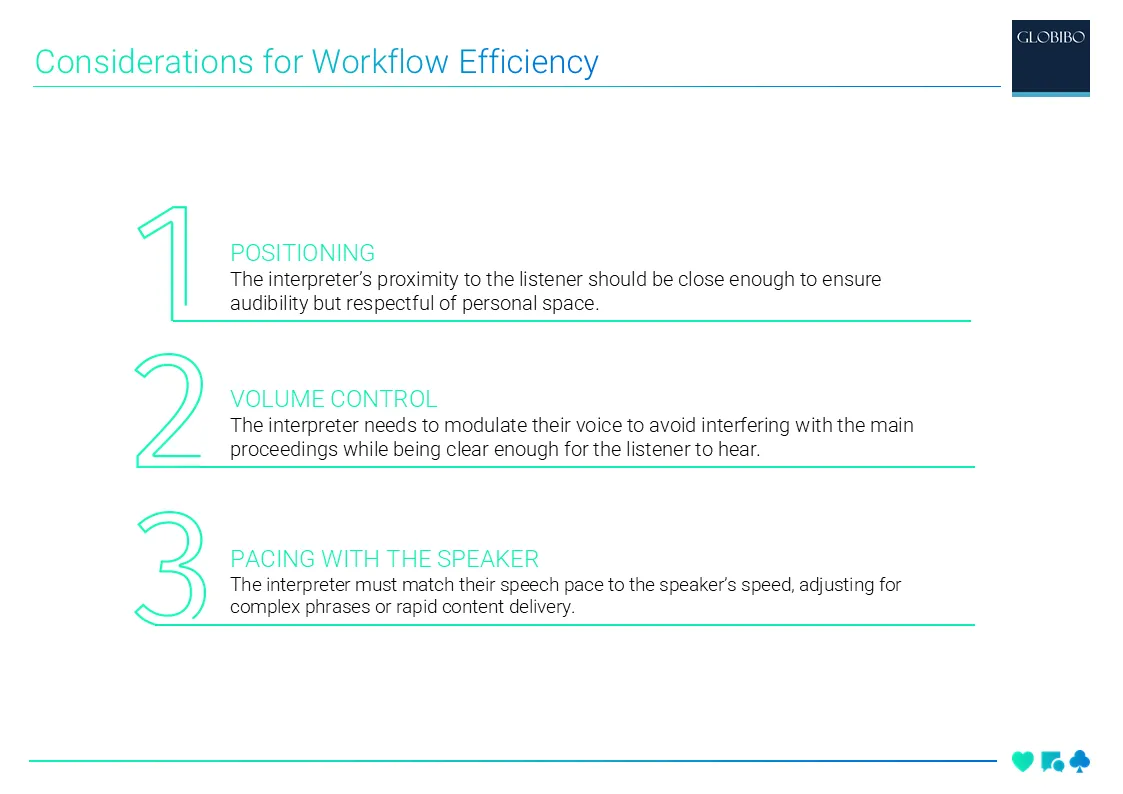
2. Considerations for Workflow Efficiency
- Positioning: The interpreter’s proximity to the listener should be close enough to ensure audibility but respectful of personal space.
- Volume Control: The interpreter needs to modulate their voice to avoid interfering with the main proceedings while being clear enough for the listener to hear.
- Pacing with the Speaker: The interpreter must match their speech pace to the speaker’s speed, adjusting for complex phrases or rapid content delivery.
Click here to learn about A Beginner’s Guide to Whispered Interpreting.
Skill Set Required for Whispered Interpretation
Whispered interpretation demands an extensive array of skills beyond language proficiency. The effectiveness of whispered interpretation hinges on the interpreter’s mental agility, vocal control, and technical knowledge.
1. Core Competencies
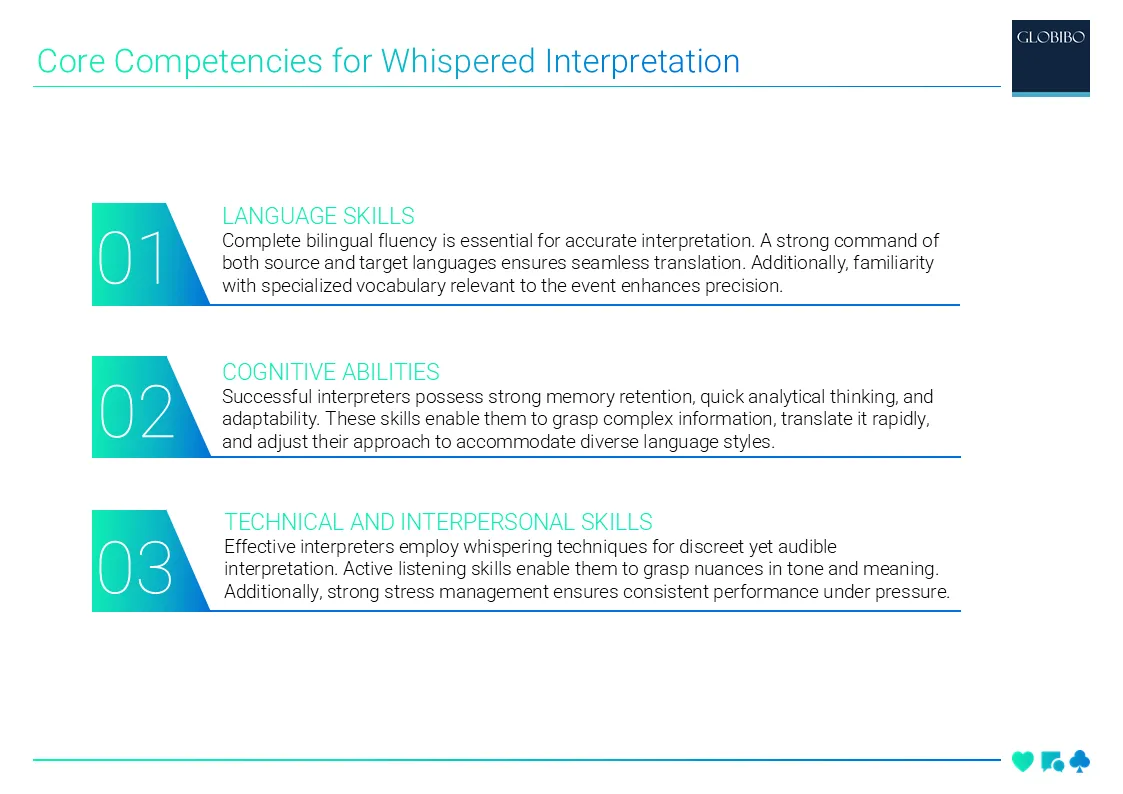
- Language Skills
- Complete Bilingual Fluency: Mastery in both the source and target languages, allowing for seamless translation.
- Specialized Vocabulary: Familiarity with terminologies relevant to the event (e.g., legal, medical, technical) ensures precise interpretation.
- Cognitive Abilities
- Memory Retention: The ability to retain and process complex information quickly.
- Quick Analytical Thinking: Interpreters must understand, mentally translate, and deliver the content almost instantaneously.
- Adaptability: Flexibility to adjust interpretation strategies when the speaker uses idioms, metaphors, or uncommon terminology.
- Technical and Interpersonal Skills
- Whispering Technique: The ability to modulate voice levels for discreet yet audible interpretation.
- Active Listening: Focused listening skills that allow the interpreter to pick up on tone, emphasis, and subtle shifts in meaning.
- Stress Management: Maintaining composure under pressure to ensure consistency in translation.
2. Interpersonal and Situational Awareness
Interpreters need to exhibit strong interpersonal skills, including empathy and active feedback, to ensure effective communication. They should be attuned to the listener’s reactions and ready to adjust the pace or rephrase content for clarity when needed.
Practical Applications of Whispered Interpretation
Whispered interpretation can be applied across various settings where a small audience requires simultaneous translation. These use cases often demand discretion, immediacy, and a high level of linguistic competence.
Common Use Cases:
- Diplomatic Negotiations: When confidentiality and a high level of understanding are critical, whispered interpretation provides an ideal solution.
- Legal Hearings: Used to ensure that non-native speakers understand proceedings, adhering to legal fairness and transparency.
- Corporate Board Meetings: Effective in multi-lingual environments where one or two participants need translation without the interruption of the main discourse.
| Application Type | Typical Environment | Audience Size | Equipment Needed | Considerations |
| Diplomatic Discussions | Embassies, international summits | 1-2 individuals | Optional personal headsets | High need for confidentiality |
| Courtroom Interpretation | Court sessions | 1 defendant | None required | Adheres to legal requirements |
| High-Level Business Meetings | Boardrooms, strategy sessions | 1-2 participants | Minimal, possibly wireless mics | Ensures uninterrupted session flow |
| Medical Consultations | Hospitals, clinics | 1 patient | None required | Quick adaptation to medical terminology |
Advantages and Limitations of Whispered Interpretation

1. Advantages
Whispered interpretation offers several unique benefits, making it an indispensable tool in specific situations:
- Low-Cost Solution: Unlike full simultaneous interpretation setups, whispered interpretation requires minimal equipment, thus lowering costs.
- Immediate Communication: Provides real-time feedback and response, enhancing the participant’s ability to engage in discussions.
- Discreet and Non-Intrusive: Maintains a low profile and does not disturb other participants, which is ideal for small group settings.
2. Challenges
While effective, whispered interpretation comes with limitations that must be addressed to optimize its use:
- Limited Audience Size: Due to the low volume, only one or two individuals can benefit from whispered interpretation.
- Interpreter Fatigue: The intense focus required can lead to rapid onset of mental and vocal fatigue, impacting performance.
- Environmental Constraints: Ambient noise can interfere with the clarity of interpretation, making certain venues less suitable.
Detailed Challenges Table:
| Challenge | Impact on Interpretation | Mitigation Strategies |
| Limited Projection | Affects audibility beyond 2 participants | Use portable amplification devices if needed |
| Interpreter Fatigue | Reduces accuracy over prolonged periods | Schedule breaks and alternate interpreters |
| Ambient Noise | Reduces clarity in noisy environments | Choose quieter locations or use headsets |
Structured Lists on Key Aspects of Whispered Interpretation
1. Benefits of Whispered Interpretation
- Cost-Efficiency: Minimal reliance on technical equipment lowers overall expenses.
- Ease of Setup: Quick to organize without the need for soundproof booths.
- Real-Time Interaction: The listener can engage in conversations seamlessly with immediate interpretation.
- Privacy: Maintains discretion, especially valuable in confidential settings.
2. Limitations and How to Address Them
- Restricted Audience Size: Limited to one or two participants. Solution: Use electronic aids if additional listeners require interpretation.
- Vocal Strain for Interpreters: Continuous whispering can lead to vocal fatigue. Solution: Implement rest periods or use dual interpreters for long sessions.
- Noise Disruption: Background noise can affect interpretation. Solution: Position in quieter areas or use headsets with noise-cancelling microphones.
- Proximity Requirements: The interpreter must be physically close to the listener. Solution: Adopt portable wireless systems for flexibility.
Advanced Techniques and Technology Integration
While traditional whispered interpretation relies on minimal equipment, integrating technology can enhance the process:
- Portable Wireless Transmitters: Devices that help project the interpreter’s voice directly to the listener’s earpiece.
- Noise-Cancelling Microphones: Improve voice clarity and reduce interference from ambient noise.
- Headsets with Adjustable Volumes: Allow listeners to fine-tune the audio level to their preference.
Technology Utilization Table:
| Technology | Use Case | Advantages | Disadvantages |
| Wireless Transmitters | Small meetings or tours | Enhanced clarity, portable | May require charging, potential signal loss |
| Noise-Cancelling Microphones | Environments with moderate noise levels | Reduces background noise interference | Higher initial cost |
| Personal Listening Headsets | Customizable for listener’s needs | Ensures clear communication | Maintenance and technical support needed |
Summary of Whispered Interpretation
Whispered interpretation remains a vital component in the arsenal of language services, catering to the need for immediate, small-scale interpretation without the complexities of larger-scale simultaneous interpretation systems. It provides an essential service in settings where discretion, low cost, and real-time translation are key. By understanding its processes, skills, applications, and the use of supportive technology, organizers, and interpreters can maximize its effectiveness while mitigating inherent limitations.

Susan has extensive experience in conference interpretation, simultaneous interpretation, and Consecutive Interpretation services, document localization for governmental and legal needs. Her work with embassies and government agencies ensures that documents meet specific regional requirements, making her expertise invaluable for international clients.
YouTube Videos on Whispered Interpretation
Academic References for Whispered Interpretation
- Spastic dysphonia. II. Comparison with essential (voice) tremor and other neurologic and psychogenic dysphonias
- High-Q optical whispering-gallery microresonators: precession approach for spherical mode analysis and emission patterns with prism couplers
- Working with interpreters: practical advice for use of an interpreter in healthcare
- Understanding the hidden curriculum: An essential social skill for children and youth with Asperger syndrome
- [BOOK] Interpreters and the legal process
- Quality assessment in conference and community interpreting
- [BOOK] Note-taking for consecutive interpreting: A short course
- [PDF] Deixis in Judith McNaught’s night whispers novel
- [PDF] Essentials in Interpreting Ellen G. White’s Writings to an Asian Audience
- [PDF] Recognition of word tones in whispered speech