Legal Interpreting Services for Immigration Cases
Legal interpreting services for immigration cases are essential, where accurate communication is critical to ensure that all parties fully understand the proceedings. This article delves into the significance of legal interpreting services For immigration contexts, the standards and skills required, and the implications of miscommunication. We will also explore the role of ISO standards in shaping the quality of interpreting services and provide structured lists and a table for a comprehensive understanding.
Understanding Legal Interpreting Services
Definition and Scope
Legal interpreting services involve facilitating communication between parties who speak different languages within a legal context. This includes court appearances, interviews, hearings, and other legal settings. In immigration cases, interpreters must navigate complex legal jargon, cultural nuances, and often emotionally charged situations, making their role indispensable.
The Role of Interpreting Services in Immigration Cases
Immigration cases involve various legal processes, including asylum applications, deportation hearings, visa applications, and citizenship tests. Legal interpreters assist non-native speakers in these proceedings, ensuring that their rights are protected, and they fully understand the legal implications of their cases.
Importance of Accuracy and Impartiality
In legal interpreting, accuracy is paramount. Any misinterpretation or omission can lead to significant consequences, such as wrongful deportation or denial of asylum. Additionally, interpreters must maintain impartiality, providing an unbiased translation of all statements, regardless of their personal beliefs or the case’s nature.
ISO Standards in Legal Interpreting Services
Overview of ISO Standards
The International Organization for Standardization (ISO) provides a set of standards that govern various aspects of legal interpreting services. ISO 18841:2018, for example, outlines the requirements for interpreting services, including qualifications, training, and ethics. These standards ensure consistency, reliability, and quality in interpreting services across different legal contexts.
ISO 13611:2014 – Interpreting in Community Settings
ISO 13611:2014 specifically addresses community interpreting, which includes legal interpreting in immigration cases. This standard provides guidelines for the basic principles and practices of community interpreting, including the competence of interpreters, the accuracy of interpretation, and the importance of cultural sensitivity.
Compliance and Implementation
Compliance with ISO standards is crucial for legal interpreting services providers. Adherence to these standards ensures that interpreters are adequately trained, qualified, and capable of delivering high-quality services. This compliance also enhances the credibility and reliability of the interpreting services offered, which is particularly important in sensitive immigration cases.
| ISO Standard | Description | Application in Legal Interpreting |
|---|---|---|
| ISO 18841:2018 | General requirements and recommendations for community interpreting. | Ensures interpreters meet specific qualifications and adhere to ethical guidelines. |
| ISO 13611:2014 | Guidelines for community interpreting, focusing on competence, accuracy, and cultural sensitivity. | Provides a framework for interpreting immigration cases, ensuring accurate and culturally aware communication. |
| ISO 9001:2015 | Quality management systems – Requirements. | Used by interpreting service providers to ensure consistent quality and continuous improvement in service delivery. |
Challenges in Legal Interpreting for Immigration Cases
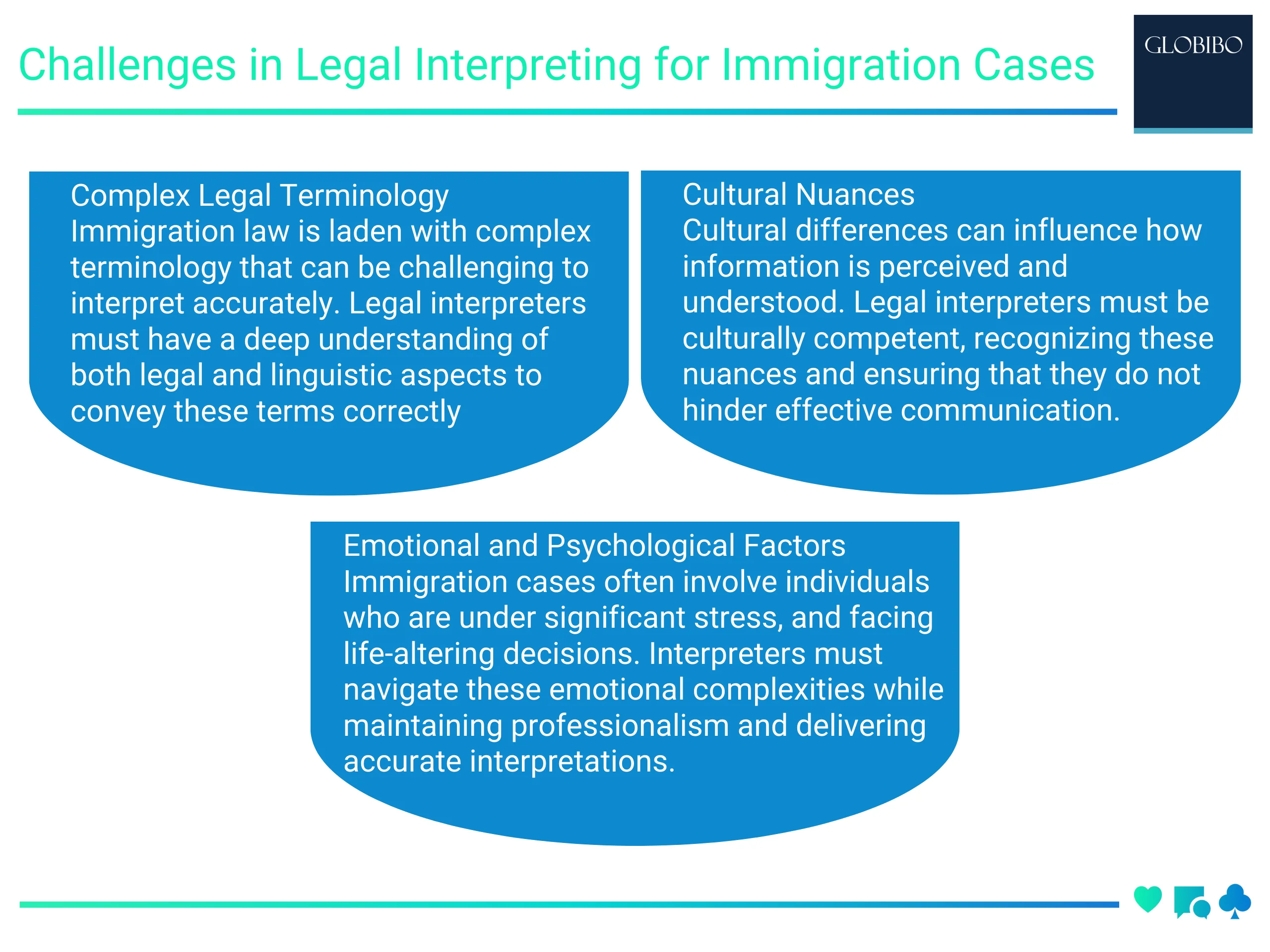
Complex Legal Terminology
Immigration law is laden with complex terminology that can be challenging to interpret accurately. Legal interpreters must have a deep understanding of both legal and linguistic aspects to convey these terms correctly.
Emotional and Psychological Factors
Immigration cases often involve individuals who are under significant stress, and facing life-altering decisions. Interpreters must navigate these emotional complexities while maintaining professionalism and delivering accurate interpretations.
Cultural Nuances
Cultural differences can influence how information is perceived and understood. Legal interpreters must be culturally competent, recognizing these nuances and ensuring that they do not hinder effective communication.
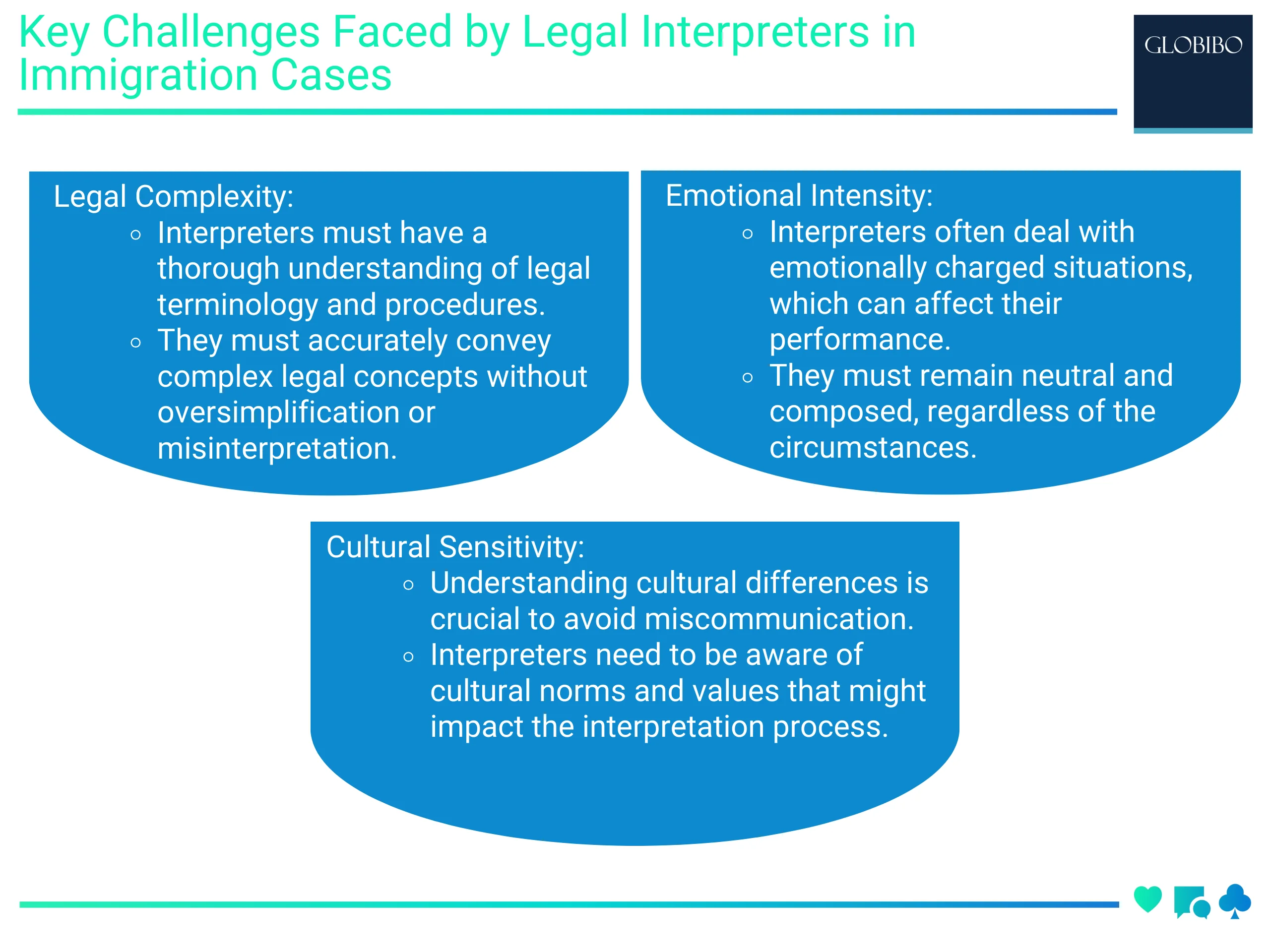
Key Challenges Faced by Legal Interpreters in Immigration Cases
- Legal Complexity:
- Interpreters must have a thorough understanding of legal terminology and procedures.
- They must accurately convey complex legal concepts without oversimplification or misinterpretation.
- Emotional Intensity:
- Interpreters often deal with emotionally charged situations, which can affect their performance.
- They must remain neutral and composed, regardless of the circumstances.
- Cultural Sensitivity:
- Understanding cultural differences is crucial to avoid miscommunication.
- Interpreters need to be aware of cultural norms and values that might impact the interpretation process.
- Ethical Considerations:
- Interpreters must adhere to a strict code of ethics, including confidentiality and impartiality.
- They should avoid conflicts of interest and maintain professionalism at all times.
Best Practices in Legal Interpreting for Immigration Cases
Continuous Training and Certification
To maintain high standards, legal interpreters must engage in continuous professional development. Certification programs, such as those aligned with ISO standards, ensure that interpreters are up-to-date with legal and linguistic advancements.
Use of Technology
Advancements in technology, such as remote interpreting services, have transformed the field. Legal interpreters can now provide services across borders, offering flexibility and access to expertise that may not be available locally.
Ethical Guidelines and Confidentiality
Legal interpreters must adhere to strict ethical guidelines. This includes maintaining confidentiality, especially in sensitive immigration cases, where the disclosure of information could have serious consequences.
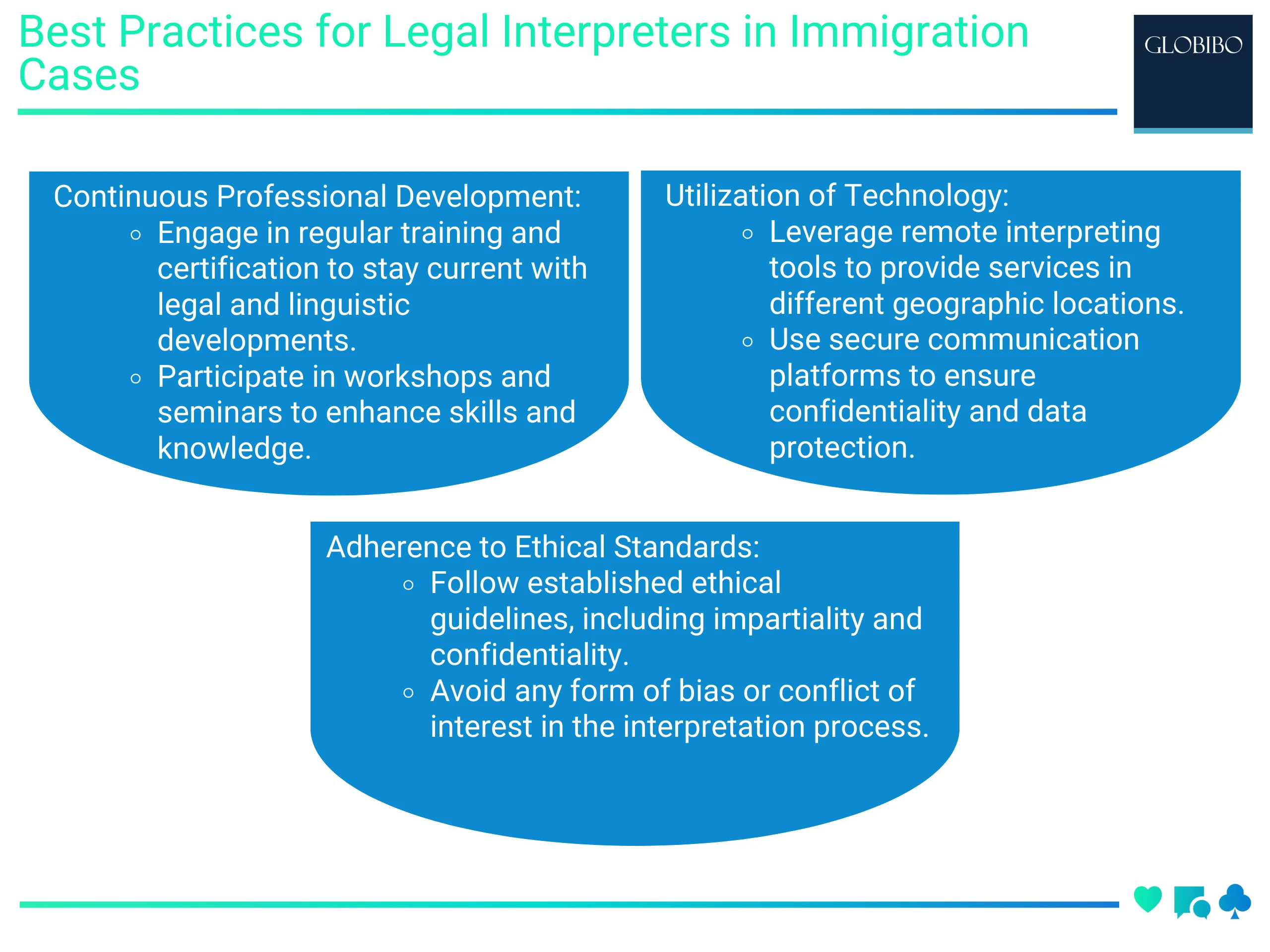
Best Practices for Legal Interpreters in Immigration Cases
- Continuous Professional Development:
- Engage in regular training and certification to stay current with legal and linguistic developments.
- Participate in workshops and seminars to enhance skills and knowledge.
- Utilization of Technology:
- Leverage remote interpreting tools to provide services in different geographic locations.
- Use secure communication platforms to ensure confidentiality and data protection.
- Adherence to Ethical Standards:
- Follow established ethical guidelines, including impartiality and confidentiality.
- Avoid any form of bias or conflict of interest in the interpretation process.
- Cultural Competency Training:
- Participate in cultural competency training to better understand and navigate cultural differences.
- Apply cultural awareness in interpreting to avoid misunderstandings and miscommunications.
The Impact of Effective Legal Interpreting Services
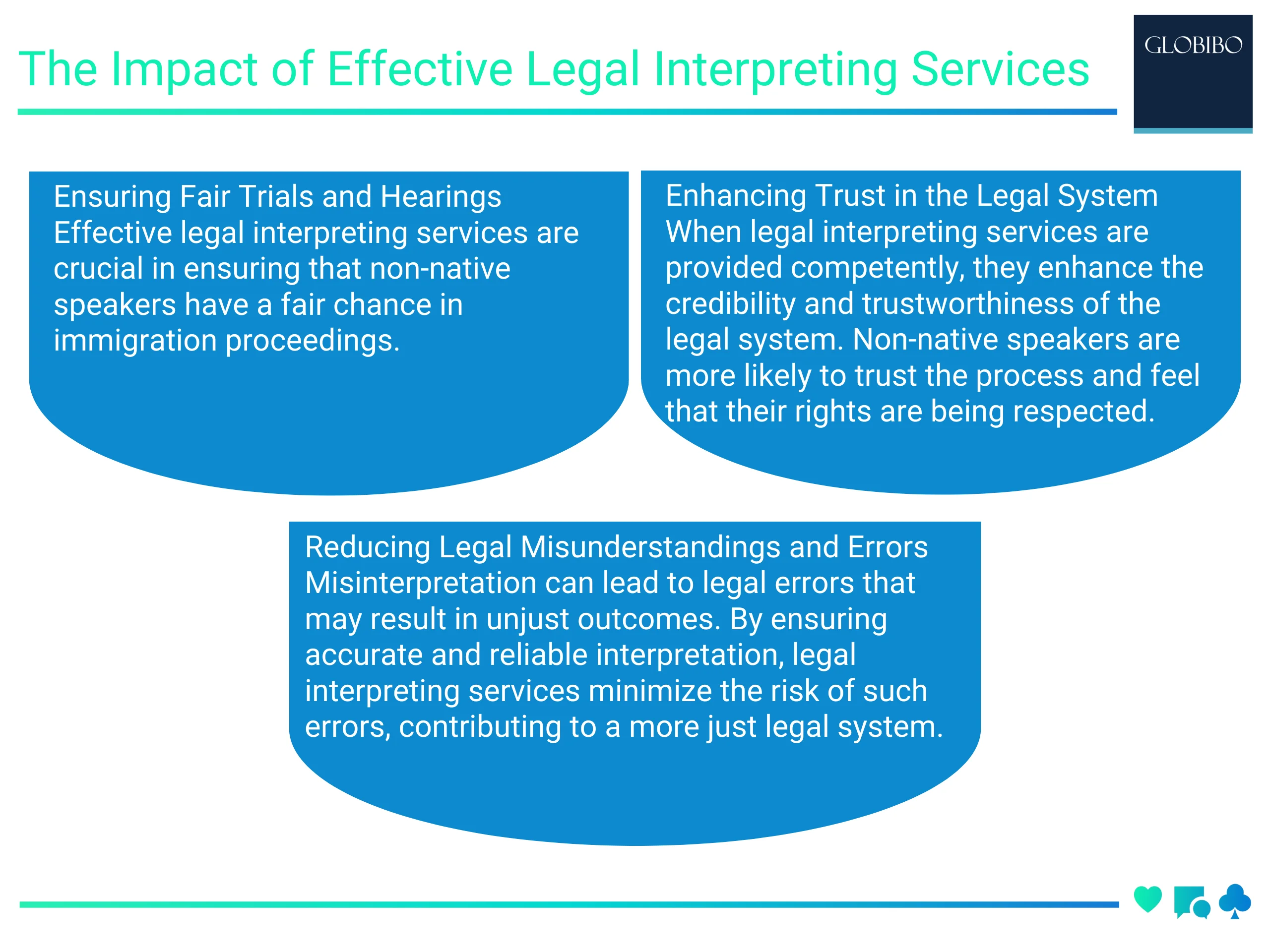
Ensuring Fair Trials and Hearings
Effective legal interpreting services are crucial in ensuring that non-native speakers have a fair chance in immigration proceedings. Accurate interpretation allows individuals to present their cases fully, understand the charges against them, and participate meaningfully in the process.
Enhancing Trust in the Legal System
When legal interpreting services are provided competently, they enhance the credibility and trustworthiness of the legal system. Non-native speakers are more likely to trust the process and feel that their rights are being respected.
Reducing Legal Misunderstandings and Errors
Misinterpretation can lead to legal errors that may result in unjust outcomes. By ensuring accurate and reliable interpretation, legal interpreting services minimize the risk of such errors, contributing to a more just legal system.
Legal Interpreting Services for Immigration Cases Summary
Legal interpreting services for immigration cases play a vital role, in ensuring that language barriers do not impede justice. Adherence to ISO standards, continuous training, and the application of best practices are essential in providing high-quality interpreting services. As immigration laws and global mobility continue to evolve, the demand for skilled legal interpreters will only increase, making their role more crucial than ever.
Academic References On Legal Interpreting Services for Cases
-
Interpreting in the gray zone: Where community and legal interpreting intersect
-
Court interpreting: Linguistic presence v. linguistic absence
-
Dialogue interpreting: A guide to interpreting in public services and the community
YouTube video on Legal Interpreting Services for Immigration Cases

Susan Tan
Leadership Development Trainer
Susan has extensive experience in document localization for governmental and legal needs. Her work with embassies and government agencies ensures that documents meet specific regional requirements, making her expertise invaluable for international clients.