Conference Equipment & Settings
Conference equipment connects speakers, presenters, interpreters, audiences, and remote participants through coordinated audio, video, presentation, networking, recording, and control systems. The configuration depends on the conference format, venue, audience capacity, languages, and program requirements.
Globibo develops generative & engaging Event Technology Solutions to excite Attendees & create Opportunities for Growths. Request a conference equipment consultation to define the equipment and settings required for your event.
Conference Equipment Overview
Conference equipment includes the technical systems used to capture, process, distribute, display, record, and stream event content. A suitable setup may combine microphones, speakers, consoles, interpretation systems, displays, cameras, recording systems, networking, and related event technology.
Equipment selection should follow the event program rather than a fixed equipment list. Room size, seating arrangement, speaker positions, audience numbers, language requirements, presentation formats, remote participation, recording requirements, and venue infrastructure all affect the final configuration.
Globibo’s Event Technology USP combines creative production, scalable platforms, and reliable on-site technology across physical, hybrid, and virtual formats — with ISO 20121 (Event Sustainability), ISO 27001 (Information Security), and ISO 9001 (Quality Management).
Review the conference equipment options or review the configuration settings used to plan an event technology setup.
Conference Equipment
1. Audio Equipment
Audio equipment provides the primary communication path between speakers and participants. Depending on the room and event format, this can include PA systems, loudspeakers, amplifiers, digital audio mixers, audio processors, stage boxes, signal splitters, monitors, and recording interfaces.
Audio configuration should account for room acoustics, speaker positions, audience coverage, feedback control, signal routing, and the number of independent audio channels required.
2. Microphones & Consoles
Conference microphones may include tabletop delegate microphones, chairman microphones, wireless microphones, handheld microphones, lapel microphones, headset microphones, and digital multifunction conference microphones.
Conference control units and microphone systems can manage speaker activation, audio routing, interpretation feeds, and delegate participation. The selected system should match the number of speakers, simultaneous sessions, room layout, and required control workflow.
3. Interpretation Equipment & Standards
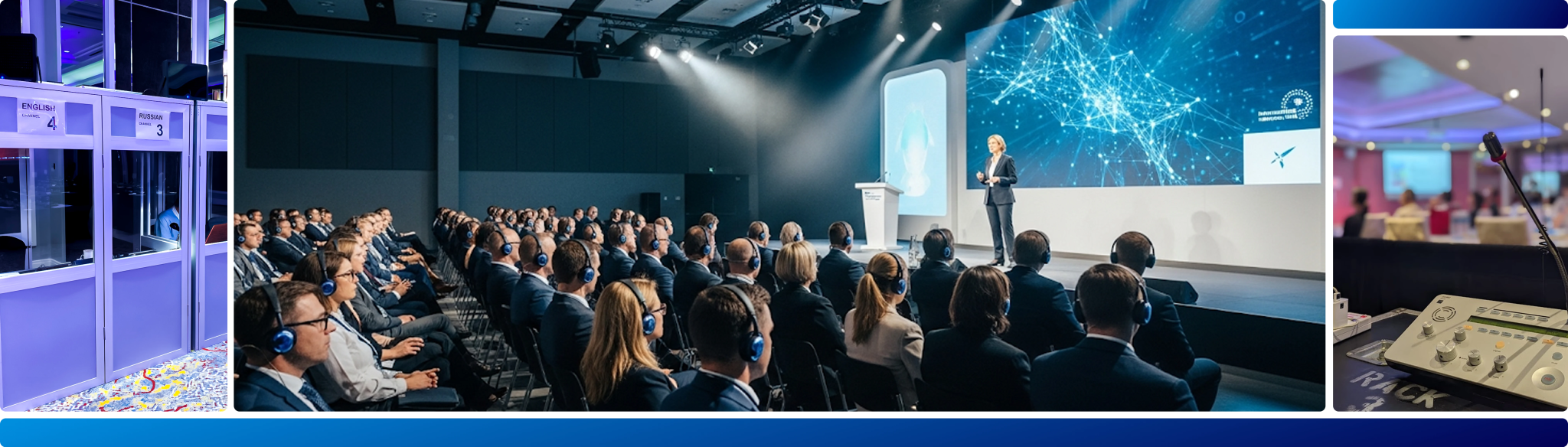
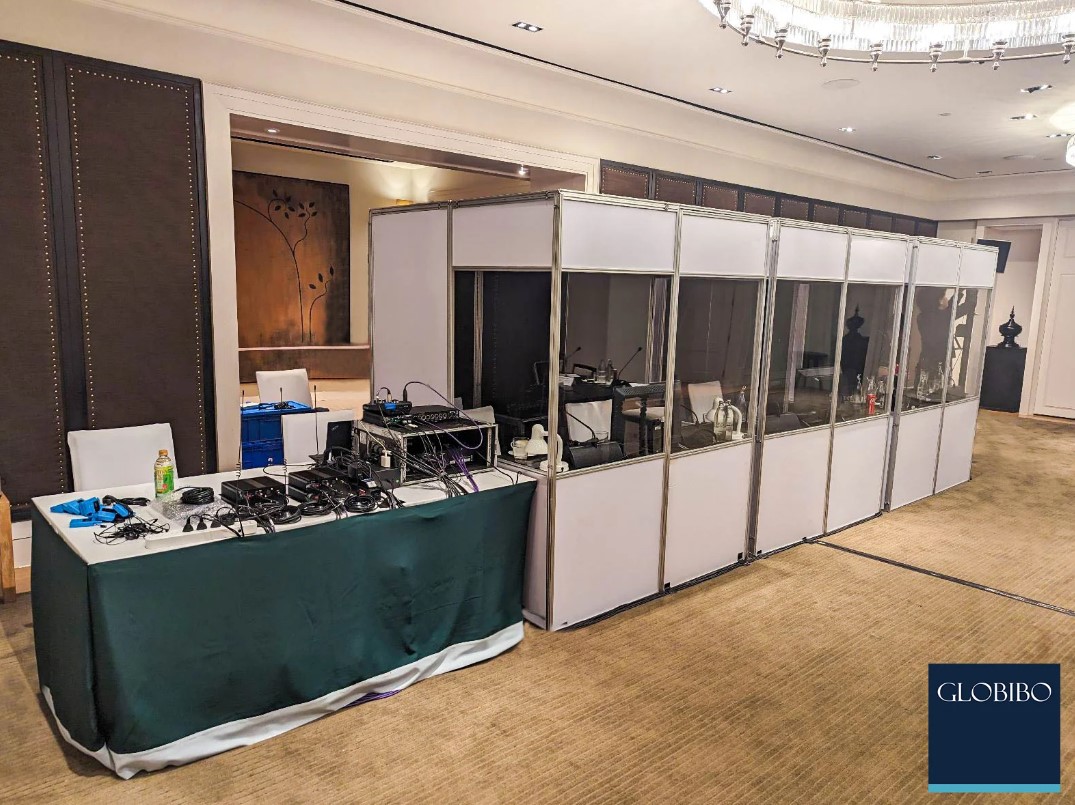
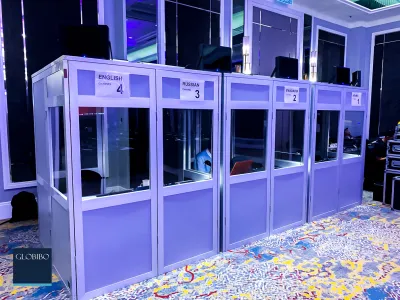
Multilingual conferences may require interpretation booths, interpreter consoles, transmitters, receivers, headphones, central control units, and dedicated language channels. Globibo can configure interpretation equipment as part of a wider conference technology setup.
ISO 22259:2019 specifies requirements for typical conference systems, including microphones, headphones, sound reinforcement, and related conference-system functions. ISO 20109:2025 addresses simultaneous interpreting equipment and the quality of sound and image transmitted to interpreters and audiences.
For interpreting booths, ISO 17651-1:2024 covers permanent simultaneous interpreting booths, while ISO 17651-2:2024 covers mobile simultaneous interpreting booths. ISO 17651-3:2026 addresses interpreting hubs, including technical infrastructure, equipment, operation, and technical support.
These standards should be considered as technical references for system design and configuration. They should not be confused with Globibo’s company-level ISO certifications.
4. Presentation Equipment
Presentation systems support speakers, moderators, presenters, and session operators. Equipment can include presentation computers, confidence monitors, clickers, signal converters, switching systems, preview displays, and presentation control interfaces.
The configuration should allow presenters to change content efficiently while maintaining the correct feed for audience displays, recording systems, streaming platforms, and remote participants.
5. Video & Display Equipment
Video systems may include projectors, LED displays, confidence monitors, presentation screens, cameras, video switchers, distribution systems, multiview displays, and monitoring equipment.
Large or multi-room conferences require careful signal distribution so that the correct video source reaches each room, control position, recording system, and streaming destination.
6. Recording & Streaming Equipment
Recording and streaming systems capture conference sessions for remote participation, post-event access, documentation, or content production. Equipment may include digital audio workstations, recording devices, video encoders, streaming servers, cameras, audio interfaces, and video distribution systems.
For larger events, recording and streaming should be designed together with audio routing, video distribution, network infrastructure, interpretation channels, and backup workflows.
Discuss your conference equipment requirements with a specialist.

Conference Equipment Settings
1. Audio Settings
Audio settings define microphone gain, speaker levels, monitor feeds, channel routing, equalization, mixing, and recording feeds. The objective is to provide consistent intelligibility across the audience area while maintaining appropriate levels for interpreters, recording, and streaming.
2. Microphone Settings
Microphone settings depend on microphone type, speaker distance, room acoustics, and the conference control system. Digital conference systems may also require microphone priority, activation, delegate management, and chairman-control settings.
3. Interpretation Settings
Interpretation settings determine source-language feeds, target-language channels, interpreter console routing, transmitter configuration, receiver distribution, and monitoring. Multilingual events may require several language channels and dedicated technical monitoring.
For remote interpretation, the configuration additionally needs stable audio and video feeds, appropriate network infrastructure, interpreter access, and centralized technical monitoring.
4. Presentation Settings
Presentation settings define the routing of speaker content to projectors, LED displays, confidence monitors, recording systems, and streaming outputs. Testing should include presentation switching, resolution, aspect ratio, signal conversion, and backup content sources.
5. Video Settings
Video settings cover camera framing, switching, display outputs, monitoring, video distribution, recording, and streaming. Multi-room events may require centralized signal management to coordinate feeds between rooms and technical control positions.
6. Network & Signal Settings
Network and signal configuration becomes particularly important when conference equipment connects multiple rooms, venues, remote interpreters, streaming systems, or cloud platforms. Network planning should consider bandwidth, segmentation, access points, redundancy, signal transport, and monitoring.
In large multilingual deployments, audio, video, interpretation, and platform traffic may need separate or controlled network paths to maintain predictable performance.
Conference Technology Applications
1. Corporate Conferences
Corporate conferences commonly require presentation systems, microphones, PA systems, displays, recording, streaming, and audience-management technology. Equipment can be configured around plenary sessions, breakout rooms, executive meetings, and parallel tracks.
2. Multilingual Conferences
Multilingual conferences add interpretation infrastructure to the standard conference equipment stack. This may include booths, interpreter consoles, transmitters, receivers, headphones, language channels, interpretation hubs, and remote interpreter connections.
3. Hybrid Conferences
Hybrid conferences combine physical rooms with remote participants. Equipment must connect microphones, cameras, displays, conferencing platforms, recording systems, interpretation channels, and network infrastructure so that physical and remote audiences receive the appropriate content.
4. Government & Association Events
Government, association, and international organization events may involve formal proceedings, multiple languages, large delegations, parallel sessions, recording requirements, and strict operational schedules. These environments benefit from detailed equipment planning, technical rehearsals, signal testing, and on-site support.
Review conference equipment case studies to see how different technical configurations have been deployed for large multilingual events.
Conference Equipment Case Studies
Australia: Multilingual Conference Equipment At Scale
Scope: A global financial professionals’ association brought together 5,000 participants across multiple venues in Sydney, with 40 sessions requiring language support from 26 interpreters.
Challenge: Multiple venues, limited room space, remote interpreters, centralized signal routing, dedicated networking, and AI processing had to operate as one technical environment.
Solution: The setup included 35 digital multifunction microphones, Brähler interpreting control units and consoles, Bosch transmitters and radiators, 100 digital interpreting receivers, interpreter laptops, transcription engines, video distribution, audio mixing, monitors, Cisco access points, Events.Studio soft consoles, and video streaming for remote interpreters.
Result: The system connected multiple venues through a centralized interpretation hub and supported 5,000 participants, 40 sessions, 26 interpreters, and reported feedback of 98%.
Read the Australia case study
Korea: Multilingual Media Gathering
Scope: A high-profile global media gathering brought together approximately 150 media professionals with multilingual communication requirements.
Challenge: Participants needed access to multiple language channels during a media-focused event involving English, Korean, Mandarin, Cantonese, and Thai.
Solution: Globibo supported the event with multilingual interpretation delivered through its event technology infrastructure, enabling participants to access the required language channels.
Result: The configuration supported 150 media professionals across seven language channels, providing multilingual access through the event technology environment.
Read the Korea case study
Bangkok: Conference Equipment & Technical Support
Scope: A five-day event for a major religious organization involved approximately 1,000 participants and multilingual interpretation across six languages.
Challenge: Specialized equipment had to be transported and installed at a venue that was not designed for delivery of large-scale technical items.
Solution: The setup included 600 interpretation receivers, six conference booths with interpreter consoles, two central control units, interpretation transmitters, Dante stage boxes, charging infrastructure, audio mixer desks, and DAW recording equipment.
Result: Globibo coordinated planning, logistics, technical operation, customer service, equipment management, and recording. Six audio channels were recorded in parallel for post-processing.
Read the Bangkok case study
Conference Equipment Consultation
With over 10 years of experience in academic event technology and conference orchestration, Rick specializes in deploying broadcast-grade hybrid symposium platforms, peer-review management systems, audience response keypads, and real-time multilingual interpretation infrastructure for global research institutions.
Susan has extensive experience in conference interpretation, simultaneous interpretation, and document localization for governmental and legal needs. Her work with embassies and government agencies supports multilingual projects requiring regional and language-specific expertise.
FAQs on Conference Interpretation
1. What equipment is needed for a conference?
Typical requirements may include microphones, speakers, audio mixers, presentation equipment, displays, cameras, recording systems, networking, and technical control systems.
2. How do I determine the right Conference Equipment configuration?
The configuration depends on the event format, venue, audience size, room layout, presentation requirements, languages, recording requirements, and remote participation.
3. What Conference Equipment is required for a multilingual event?
Multilingual conferences may require interpretation booths or hubs, interpreter consoles, transmitters, receivers, headphones, central control units, and separate language channels.
4. What ISO standard applies to Conference Systems?
ISO 22259:2019 specifies requirements for typical conference systems, including microphones, headphones, sound reinforcement, and related conference-system functions.
5. What ISO standard applies to Simultaneous Interpreting Equipment?
ISO 20109:2025 addresses simultaneous interpreting equipment and the quality of sound and image transmitted to interpreters and audiences.
6. What standards apply to Interpretation Booths?
ISO 17651-1:2024 covers permanent simultaneous interpreting booths, while ISO 17651-2:2024 covers mobile simultaneous interpreting booths.
7. What is an Interpreting Hub?
An interpreting hub coordinates interpreting-related equipment, communication infrastructure, technical control, and operational support. ISO 17651-3:2026 addresses interpreting hubs and their technical and operational requirements.
8. What equipment is required for a Hybrid Conference?
A hybrid conference may require microphones, cameras, displays, video conferencing infrastructure, audio and video distribution, network equipment, recording systems, streaming infrastructure, and remote-interpreter connectivity.
9. Can Conference Equipment support recording and streaming?
Yes. Conference equipment can be integrated with audio recording, video recording, streaming, signal distribution, and remote participation systems.
10. Should Conference Equipment be tested before the event?
Yes. Testing should cover microphones, audio levels, interpretation channels, presentation sources, video signals, recording, streaming, network connectivity, signal routing, and backup workflows.
YouTube Video on Conference Equipment & Settings