Conference Interpreting Services
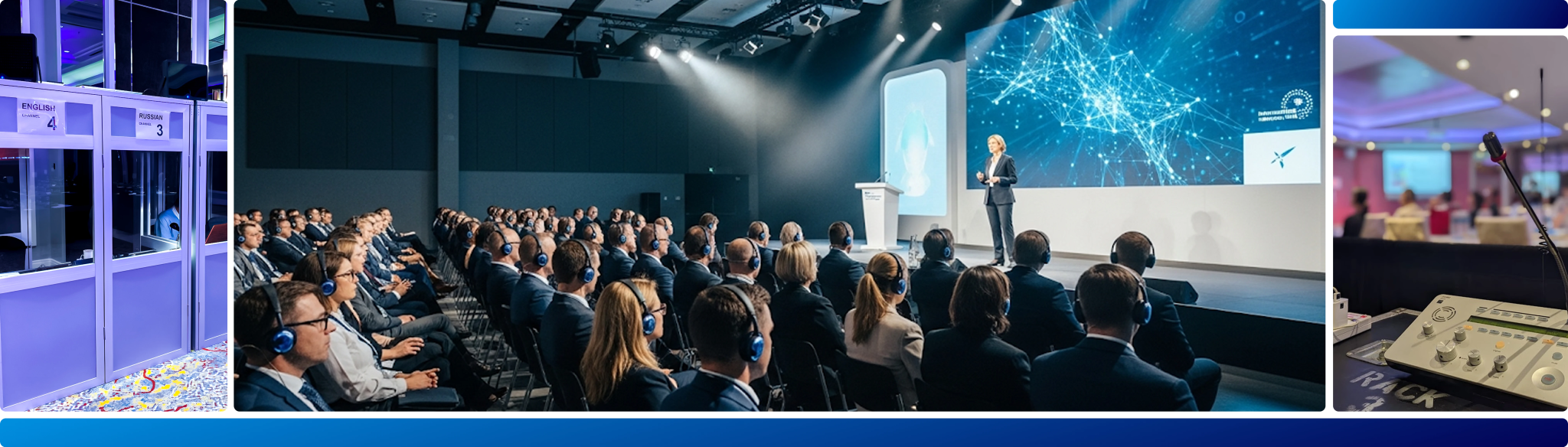
Conference Interpreting Services enable multilingual conferences, summits, congresses, and institutional meetings to communicate across languages without interrupting the live program. They combine qualified interpreters, appropriate interpreting modes, technical infrastructure, and preparation.
For organizers, the main decisions are the interpreting mode, language combinations, interpreter team, venue or remote setup, equipment, and preparation requirements. Contact Us to discuss the language, format, audience, and technical requirements for your conference.
Conference Interpretation Overview
Conference interpreting converts spoken communication between languages while an event is taking place. Depending on the program, interpreters may work simultaneously with the speaker, consecutively after short segments, or through other specialized arrangements.
The appropriate configuration depends on the number of languages, session format, audience size, venue acoustics, speaker behavior, confidentiality requirements, and whether participants attend physically, remotely, or through a hybrid setup.
Globibo provides Language Services solutions with unrivaled speed, cost-efficiency, and quality to empower & engage People in Communication.
Conference interpreting can support:
- International conferences and congresses
- Government and diplomatic meetings
- Association and institutional events
- Bilateral and multilateral meetings
- Executive and corporate conferences
- Product launches and media events
- Legal and regulatory meetings
- Training conferences and seminars
- Hybrid and remote conferences
Conference Interpreting Capabilities
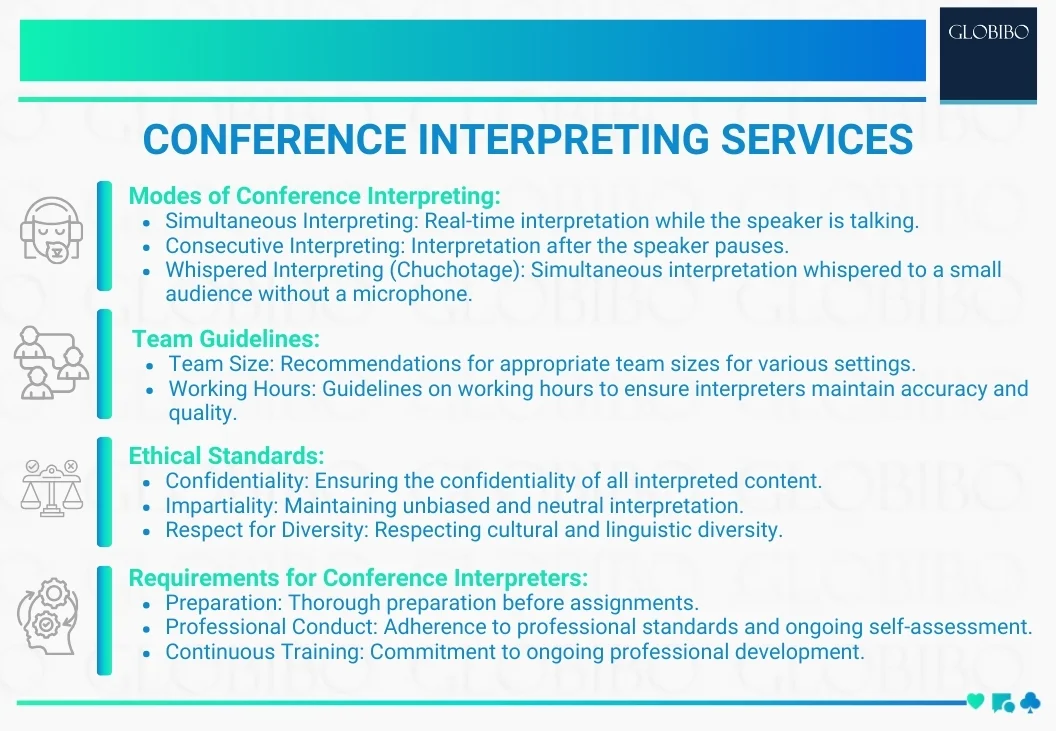
Interpreting Modes
The interpreting mode should follow the communication structure rather than being selected solely according to venue or audience size.
Simultaneous Interpretation
The interpreter listens to the speaker and delivers the target-language interpretation with minimal delay. Simultaneous interpretation is commonly used when participants need continuous access to the spoken content without waiting for each statement to finish.
It normally requires appropriate audio transmission, interpreter consoles, monitoring equipment, and a suitable working environment.
Consecutive Interpretation
The speaker pauses after a segment of speech while the interpreter delivers the corresponding consecutive interpretation. This format can work for smaller meetings, bilateral discussions, interviews, presentations, and settings where continuous simultaneous interpretation is not required.
Whispered Interpretation
The interpreter provides low-volume simultaneous interpretation directly to a small number of listeners. It can be useful when only a limited number of participants require another language and installing a full conference interpretation system is unnecessary.
Remote Interpretation
Interpreters work from a remote location while participants and speakers connect through an online or hybrid event environment. The technical configuration for remote interpretation must account for audio routing, interpreter access, platform compatibility, network stability, and participant listening requirements.
The choice between these modes depends on the event format, number of listeners, language combinations, room configuration, and technical infrastructure.
Interpreter Teams
Long or technically demanding simultaneous sessions generally require more than one interpreter for a language combination. Team configuration depends on session duration, subject complexity, working conditions, number of languages, and program structure.
Preparation materials can include:
- Conference agendas
- Speaker presentations
- Terminology lists
- Technical documentation
- Previous speeches
- Organization-specific terminology
- Names and titles of speakers
- Regulatory or institutional documents
Providing reference material before the event allows interpreters to prepare terminology and subject-specific concepts before the live session.
Ethical Standards
Conference interpreters work with information that can include commercial, governmental, legal, financial, or personally sensitive material. Professional practice therefore requires attention to confidentiality, impartiality, accuracy, professional conduct, and appropriate handling of source materials.
Organizers should also establish clear procedures for distributing presentation material and managing confidential documents before and after the conference.
Interpreter Qualifications
Interpreter selection should consider language combination, subject-matter knowledge, interpreting mode, event format, and experience with the type of conference being delivered.
For specialized events, organizers should provide sufficient background material so interpreters can prepare terminology and concepts before the assignment.
Relevant factors include:
- Target and source languages
- Conference subject
- Interpreting mode
- Session duration
- Number of sessions
- Required terminology
- Audience profile
- Physical or remote delivery
Technical Requirements
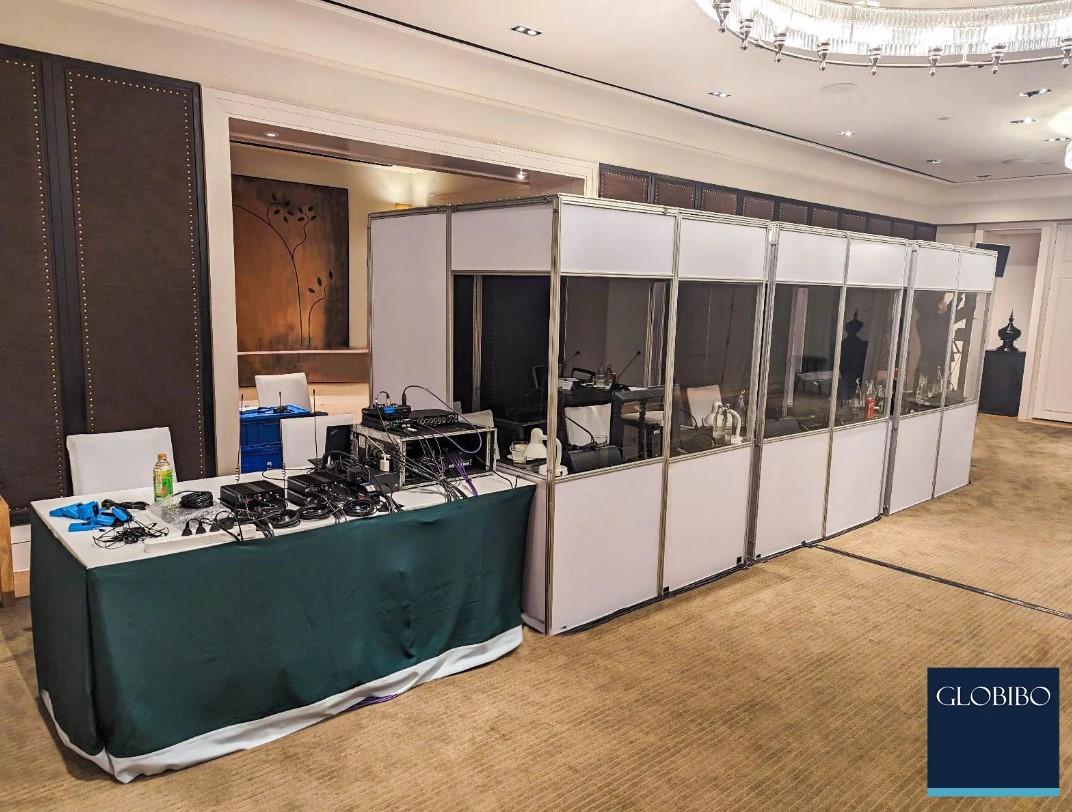
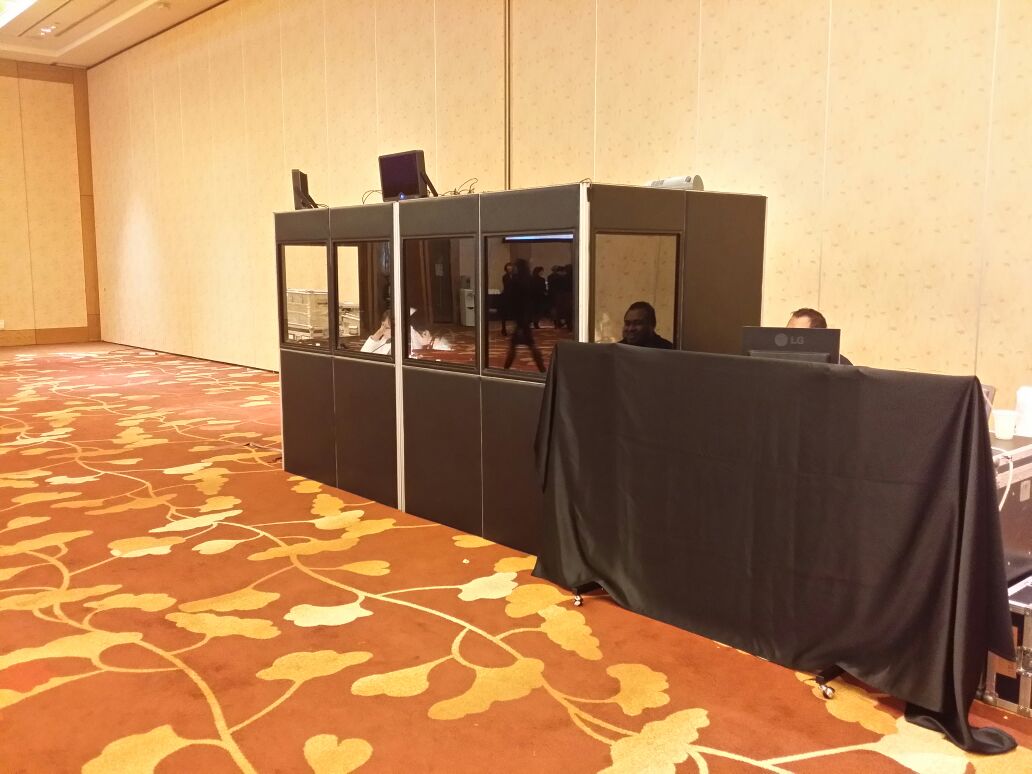
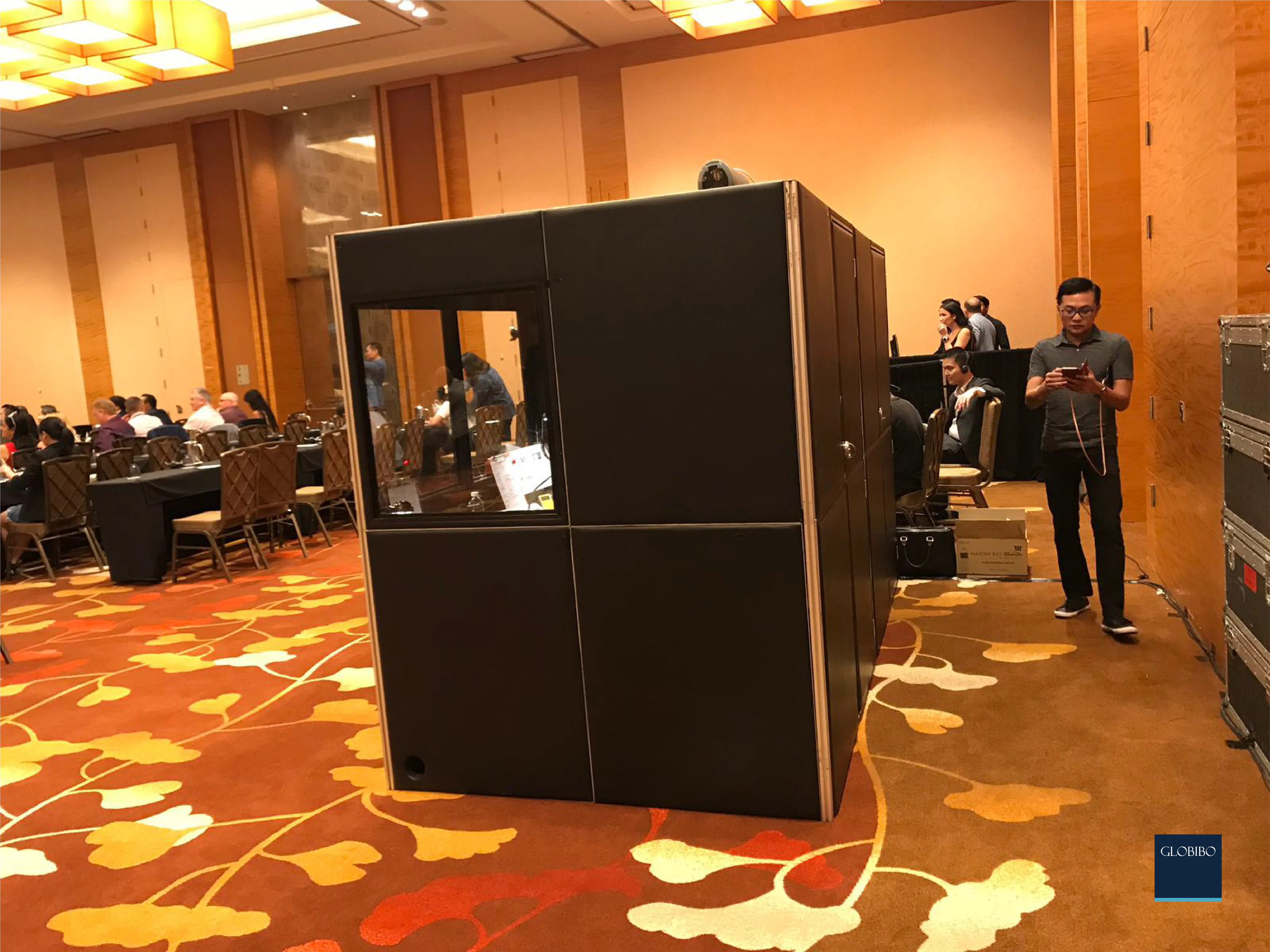
Booths & Audio Systems
Simultaneous conference interpretation requires a reliable audio chain between speakers, interpreters, and listeners.
A typical physical setup can include:
- Interpreter booths or suitable interpreter working positions
- Interpreter consoles
- Microphones
- Headphones
- Conference microphones
- Audio mixing and distribution
- Transmitters and receivers
- Audience listening devices
- Appropriate cabling and signal routing
Booth configuration should provide interpreters with clear sightlines or suitable visual access to speakers, presentation screens, and relevant event information.
Audio quality is particularly important because interpreters need to hear the source speech clearly while simultaneously producing the target-language output.
Remote & Hybrid Interpretation
Remote and hybrid conferences introduce additional technical dependencies. Audio must reach interpreters with sufficient clarity and appropriate routing, while interpreted channels must return to the relevant participants.
A technical assessment should consider:
| Requirement | Physical Conference | Remote Conference | Hybrid Conference |
|---|---|---|---|
| Interpreter location | Venue | Remote | Venue or remote |
| Source audio | Conference audio system | Online platform | Integrated venue/platform audio |
| Target audio | Receivers/headsets | Platform language channels | Receivers and/or platform channels |
| Network dependency | Lower | High | High |
| Technical coordination | Venue AV team | Online platform team | Venue + platform teams |
| Participant access | Dedicated listening equipment | Platform language selection | Both |
The appropriate configuration depends on event scale, venue infrastructure, platform capabilities, and the number of language channels required.
Conference Preparation
Preparation should begin before the event rather than at the start of the first session.
A practical preparation process includes:
- Confirm language combinations and interpreting modes.
- Review the conference agenda and session durations.
- Identify speakers and subject-matter areas.
- Collect presentations, terminology, and reference documents.
- Confirm venue, platform, and audio requirements.
- Establish interpreter team assignments.
- Test technical routing before the live event.
- Confirm communication procedures for speakers, interpreters, and technical teams.
The preparation process becomes particularly important when conferences involve technical terminology, multiple languages, parallel sessions, or sensitive subject matter.
Quality Standards
ISO 23155:2022: ISO 23155:2022 is specifically concerned with conference interpreting and provides requirements and recommendations for the provision of conference interpreting services. It addresses areas relevant to service delivery and the different parties involved in conference interpreting.
The standard can therefore be used as a reference when defining requirements for conference interpreting procurement and delivery.
Interpreting Standards
Conference interpreting can involve several standards depending on the service and operating environment.
ISO 18841:2018 provides general requirements and recommendations for interpreting services. It is broader than conference interpreting alone and covers interpreting services generally.
Other standards may apply to specific interpreting environments, technology, accessibility, or specialized requirements. The applicable standard should therefore be selected according to the actual service being procured rather than treating every interpreting standard as a conference-specific requirement.
Conference organizers should distinguish between a standard’s published scope and a provider’s own certification claims. Certification should only be stated where the relevant certification and scope have been independently verified.
Conference Interpretation Case Studies

Multilingual Interpretation Support for a Luxury Brand Event in Seoul
Globibo provided multilingual interpretation support for a luxury fashion and cosmetics APAC sales meeting in Seoul involving more than 300 attendees.
Read the full case study

Multilingual Interpretation for a High-Profile Global Media Gathering in Korea
Globibo supported a high-profile global media gathering in Korea with multilingual simultaneous interpretation infrastructure.
Want to learn more? I ‘m looking forward to hearing from you!

Susan has extensive experience in conference interpretation, simultaneous interpretation services, document localization for governmental and legal needs. Her work with embassies and government agencies ensures that documents meet specific regional requirements, making her expertise invaluable for international clients.






Request a Consultation to discuss your conference requirements and determine the appropriate interpreting configuration.
FAQs on Conference Interpretation
1. What is the scope of ISO 23155:2022 for conference interpreting?
ISO 23155:2022 addresses conference interpreting services and provides requirements and recommendations relevant to their provision. Its scope should be reviewed when defining service requirements for a conference.
2. What are the key aspects of ISO 23155:2022 in ensuring interpreting quality?
The standard provides a framework for conference interpreting service provision and addresses relevant requirements and recommendations for the parties involved in the service.
3. What ethical standards are relevant for conference interpreters?
Professional interpreting practice requires attention to confidentiality, impartiality, accuracy, professional conduct, and appropriate handling of information and materials.
4. Which Conference Interpreting Mode should be used?
The mode depends on the conference format, number of languages, number of participants requiring interpretation, session structure, venue, and available technical infrastructure.
5. What Equipment is required for Conference Interpreting Services?
Physical simultaneous interpretation may require interpreter booths or suitable working positions, interpreter consoles, microphones, headphones, audio distribution, transmitters, receivers, and related signal-routing equipment.
6. How can interpreters prepare for a conference?
Organizers can provide agendas, presentations, terminology lists, speaker information, technical documentation, previous speeches, and other relevant reference material before the conference.
7. Can Conference Interpreting Services be provided remotely?
Yes. Remote conference interpreting can be integrated with online and hybrid event environments, subject to suitable audio routing, platform functionality, interpreter access, network conditions, and participant listening arrangements.
8. Can one conference use more than one interpreting mode?
Yes. Different sessions can use different interpreting modes according to their format, audience, language requirements, and technical conditions.
9. Which ISO Standard applies specifically to conference interpreting?
ISO 23155:2022 specifically addresses conference interpreting. Other interpreting standards may apply depending on the service and operating environment.