Remote Simultaneous Interpretation Solutions For Events
In the rapidly evolving landscape of global events, the demand for seamless communication across language barriers has never been higher. As conferences, seminars, and corporate events increasingly adopt a hybrid format—combining in-person and virtual attendees—the need for efficient, reliable, and scalable interpretation solutions has become paramount.
Remote simultaneous interpretation (RSI) offers a viable solution to this challenge, enabling interpreters to deliver real-time translation from remote locations. This article delves into the technical intricacies of RSI, explores its integration into hybrid events, and provides structured insights into its operational mechanisms.
Remote Simultaneous Interpretation (RSI) is a technological solution that allows interpreters to provide real-time translation from a location separate from the event venue. Traditionally, simultaneous interpretation required interpreters to be physically present in soundproof booths at the event site.
However, advancements in communication technologies, particularly in cloud computing and high-speed internet, have facilitated the development of RSI, allowing interpreters to work from remote locations while still delivering accurate and timely translations. RSI allows interpreters to work on government sessions and business meetings more efficiently.
RSI systems typically involve a combination of specialized software, high-quality audio-visual equipment, and stable internet connections. These systems are designed to support the interpreters’ work, ensuring they receive clear audio feeds of the original speech and can broadcast their translations with minimal latency. The audience, whether onsite or online, receives the interpreted content in real time through headphones, mobile devices, or other platforms.
Technical Components of RSI Solutions
1 Core Hardware Requirements
The effectiveness of RSI largely depends on the hardware setup, which includes:
- Interpreters’ Workstations:
- High-performance computers with multi-core processors and ample RAM to handle the demands of interpretation software.
- Dual monitors to display the video feed and translation platform simultaneously.
- Professional-grade microphones and headsets to ensure clear audio input and output.
- Audio-Visual Equipment:
- High-definition cameras to capture the event’s visual content.
- Audio mixers and sound cards to manage and distribute the event’s audio feed.
- Dedicated servers or cloud-based platforms for hosting and distributing video streams.
- Networking Infrastructure:
- High-speed internet connections with low latency and high bandwidth to support uninterrupted communication.
- Redundant network setups to ensure reliability in case of primary connection failures.
2 Software and Platforms
RSI solutions rely on specialized software platforms that facilitate real-time interpretation. These platforms include:
- Interpretation Software:
- Dedicated RSI platforms that offer features such as multi-language support, interpreter handover, and real-time chat for interpreter coordination.
- Integration with video conferencing tools (e.g., Zoom, Microsoft Teams) to allow interpreters to access the event remotely.
- Audio-Visual Management Tools:
- Software for managing audio inputs and outputs, including noise cancellation, echo reduction, and audio mixing.
- Video streaming platforms that support high-definition feeds with minimal latency.
- Cloud Computing:
- Cloud-based platforms that host RSI software and enable interpreters to work from any location with internet access.
- Scalable infrastructure to handle varying numbers of participants and interpreters.
Hybrid Interpretation: Integrating RSI into Hybrid Events
1 Defining Hybrid Interpretation
Hybrid interpretation refers to the use of RSI in events that combine both in-person and virtual elements. In a hybrid event, some participants attend physically at the venue, while others join remotely via online platforms. Hybrid interpretation ensures that both onsite and remote participants receive real-time translations, regardless of their location.
The integration of RSI into hybrid events presents unique challenges, particularly in managing the technical requirements of both the onsite and online components. However, when effectively implemented, hybrid interpretation can offer a seamless and inclusive experience for all participants.
2 Technical Considerations for Hybrid Interpretation
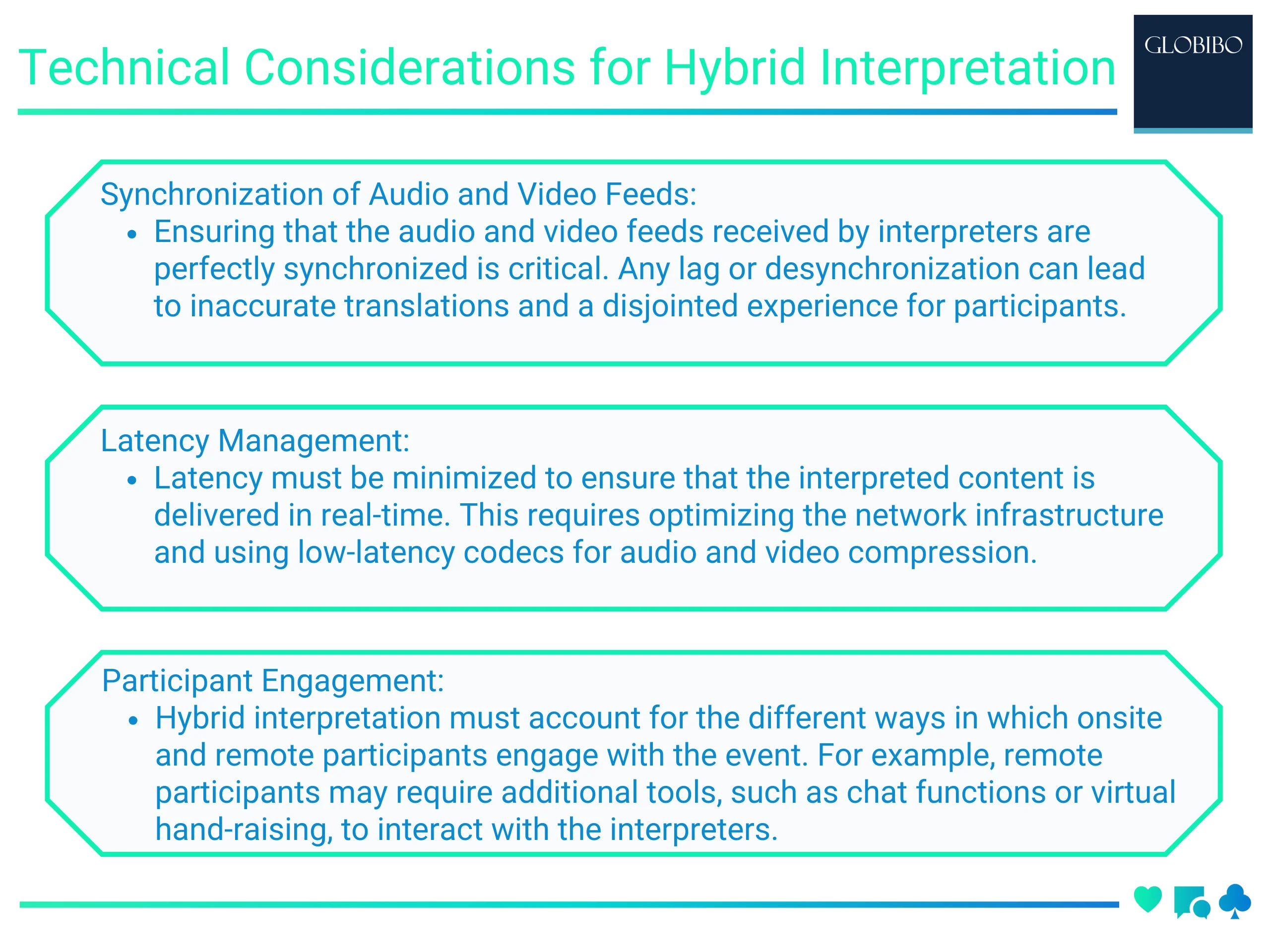
- Synchronization of Audio and Video Feeds:
- Ensuring that the audio and video feeds received by interpreters are perfectly synchronized is critical. Any lag or desynchronization can lead to inaccurate translations and a disjointed experience for participants.
- Latency Management:
- Latency must be minimized to ensure that the interpreted content is delivered in real time. This requires optimizing the network infrastructure and using low-latency codecs for audio and video compression.
- Participant Engagement:
- Hybrid interpretation must account for the different ways in which onsite and remote participants engage with the event. For example, remote participants may require additional tools, such as chat functions or virtual hand-raising, to interact with the interpreters.
3 Operational Workflow in Hybrid Events
The operational workflow for hybrid interpretation can be outlined as follows:
- Pre-Event Preparation:
- Testing of all audio-visual equipment and network infrastructure.
- Coordination with interpreters to ensure familiarity with the event’s content and technical setup.
- Integration of RSI platforms with the event’s video conferencing or live streaming tools.
- Live Event Management:
- Continuous monitoring of audio and video feeds to ensure synchronization and quality.
- Real-time technical support for interpreters and participants to address any issues that arise during the event.
- Management of interpreter handovers to maintain translation accuracy and avoid fatigue.
- Post-Event Review:
- Collection of feedback from interpreters and participants to assess the effectiveness of the interpretation.
- Analysis of any technical issues encountered and development of strategies for future events.

Advantages of RSI in Hybrid Events
1 Scalability and Flexibility
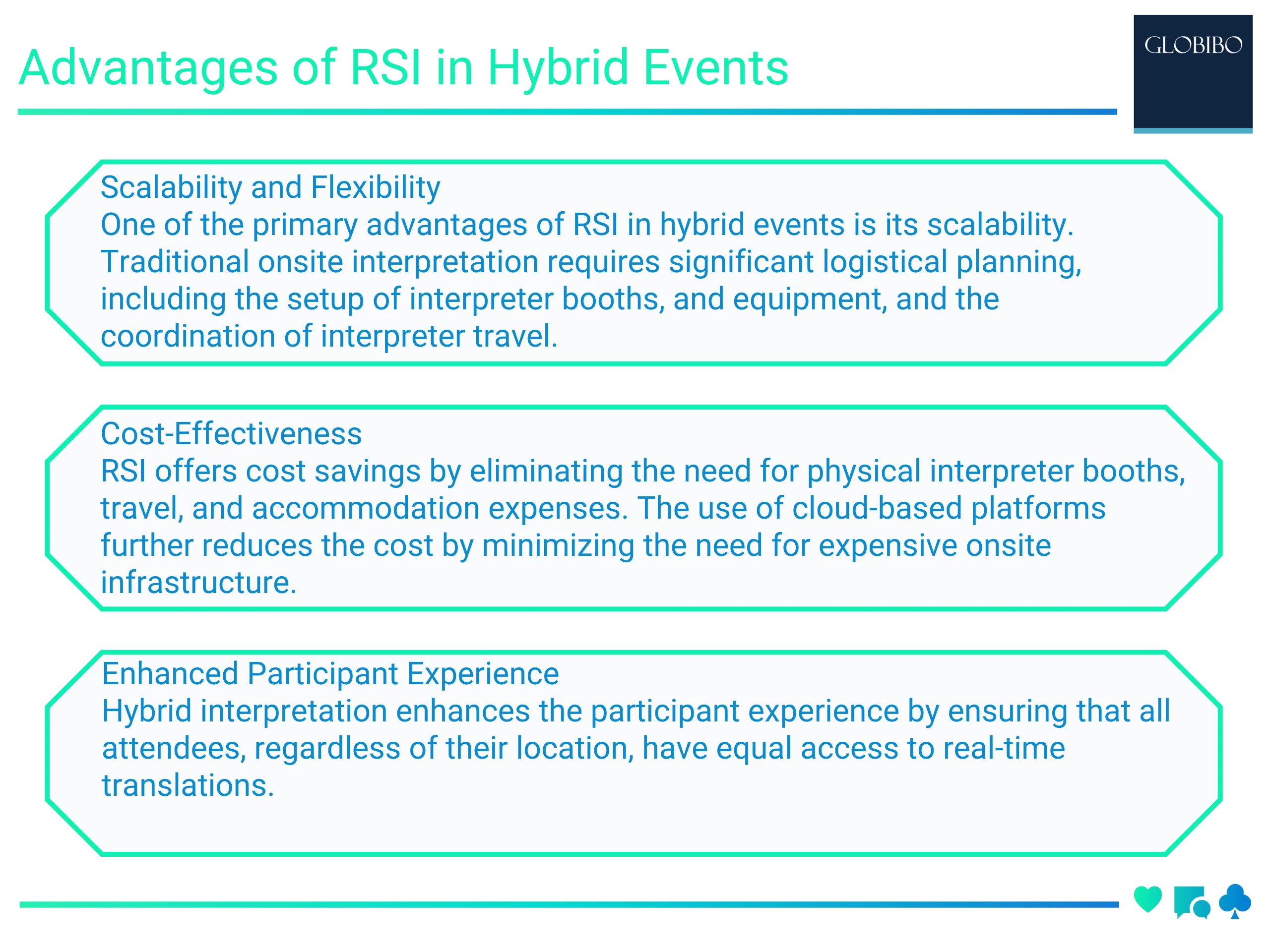
One of the primary advantages of RSI in hybrid events is its scalability. Traditional onsite interpretation requires significant logistical planning, including the setup of interpreter booths, and equipment, and the coordination of interpreter travel. In contrast, RSI allows for the deployment of interpreters from anywhere in the world, reducing the need for extensive logistical arrangements. This flexibility is particularly beneficial for large-scale events with multiple languages, as it allows organizers to quickly scale up or down based on the number of participants and languages required. When physical presence is impossible, over-the-phone interpreting (OPI) offers a practical solution to maintain communication.
2 Cost-Effectiveness
RSI offers cost savings by eliminating the need for physical interpreter booths, travel, and accommodation. The use of cloud-based platforms further reduces the cost by minimizing the need for expensive onsite infrastructure. Additionally, RSI allows for the pooling of interpreters across multiple events, optimizing resource utilization.
3 Enhanced Participant Experience
Hybrid interpretation enhances the participant experience by ensuring that all attendees, regardless of their location, have equal access to real-time translations. The ability to receive translations via personal devices, such as smartphones or tablets, adds convenience for remote participants and reduces the need for additional onsite equipment.
4 Environmental Impact
By reducing the need for interpreter travel and onsite infrastructure, RSI contributes to the reduction of the event’s carbon footprint. This aligns with the growing emphasis on sustainability in event planning and management.
Challenges and Limitations of RSI
1 Technical Challenges
- Network Reliability:
- The effectiveness of RSI is heavily dependent on the reliability of internet connections. Network disruptions can lead to loss of audio or video feeds, resulting in gaps in interpretation. To mitigate this risk, redundant network setups and failover mechanisms are essential.
- Audio Quality:
- Ensuring high-quality audio is crucial for accurate interpretation. Poor audio quality, resulting from factors such as background noise or low bandwidth, can hinder interpreters’ ability to deliver accurate translations.
- Latency Issues:
- Latency in audio or video feeds can lead to delays in interpretation, affecting the real-time nature of the service. This is particularly challenging in fast-paced events where immediate translation is required.

2 Operational Challenges
- Interpreter Fatigue:
- RSI can be mentally taxing for interpreters, particularly in long or complex events. To address this, regular breaks and handovers between interpreters are necessary. However, coordinating these handovers in a remote setup can be challenging.
- Participant Engagement:
- Ensuring that remote participants remain engaged with the event and the interpreted content can be difficult. Additional tools and features, such as interactive Q&A sessions or multilingual chat, may be required to enhance engagement.
3 Security and Privacy Concerns
- Data Security:
- The use of cloud-based platforms for RSI raises concerns about data security and privacy. It is essential to ensure that all communication channels are encrypted and that the platform complies with relevant data protection regulations.
- Confidentiality:
- In events where sensitive information is discussed, maintaining the confidentiality of the interpreted content is paramount. This requires strict access controls and secure communication protocols.
Future Trends in RSI and Hybrid Interpretation
1 AI and Machine Learning Integration
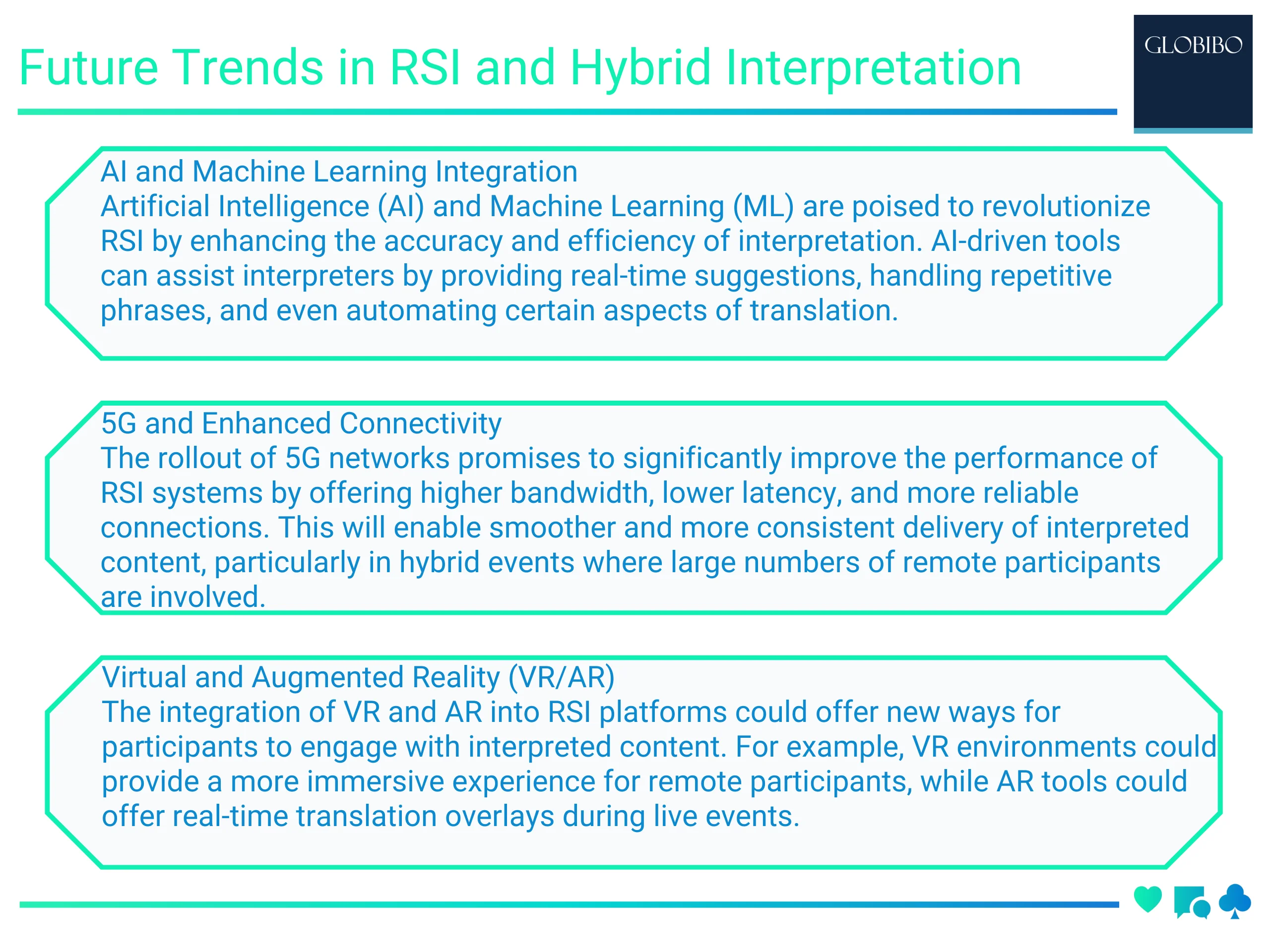
Artificial Intelligence (AI) and Machine Learning (ML) are poised to revolutionize RSI by enhancing the accuracy and efficiency of interpretation. AI-driven tools can assist interpreters by providing real-time suggestions, handling repetitive phrases, and even automating certain aspects of translation. This can reduce the cognitive load on interpreters and improve the overall quality of the interpretation.
2 5G and Enhanced Connectivity
The rollout of 5G networks promises to significantly improve the performance of RSI systems by offering higher bandwidth, lower latency, and more reliable connections. This will enable smoother and more consistent delivery of interpreted content, particularly in hybrid events where large numbers of remote participants are involved.
3 Virtual and Augmented Reality (VR/AR)
The integration of VR and AR into RSI platforms could offer new ways for participants to engage with interpreted content. For example, VR environments could provide a more immersive experience for remote participants, while AR tools could offer real-time translation overlays during live events.
4 Customization and Personalization
As RSI platforms continue to evolve, there will be an increasing focus on customization and personalization. This could include the ability for participants to choose their preferred language, adjust the audio settings, or even select different interpretation styles based on their preferences.
Best Practices for Implementing RSI in Hybrid Events
1 Pre-Event Planning
- Conduct Technical Audits:
- Perform thorough technical audits of all equipment and software to ensure compatibility and reliability.
- Engage Experienced Interpreters:
- Choose interpreters with experience in RSI and the specific subject matter of the event.
- Run Rehearsals:
- Conduct full-scale rehearsals to identify and address potential issues before the event.
2 Live Event Execution
- Provide Technical Support:
- Ensure that a dedicated technical support team is available throughout the event to address any issues promptly.
- Monitor Participant Feedback:
- Collect real-time feedback from participants to gauge the effectiveness of the interpretation and make adjustments as needed.
- Manage Interpreter Handover Smoothly:
- Coordinate interpreter handovers to avoid disruptions in the interpretation flow.
3 Post-Event Review
- Analyze Technical Performance:
- Review the technical performance of the RSI system, including any network issues, audio quality, and latency.
- Gather Interpreter Feedback:
- Collect feedback from interpreters to understand their experience and identify areas for improvement.
- Assess Participant Satisfaction:
- Evaluate participant satisfaction with the interpreted content and the overall event experience.
Core Hardware Requirements for RSI
- Interpreters’ Workstations:
- High-performance computers with multi-core processors and ample RAM.
- Dual monitors for displaying video feed and translation platform.
- Professional-grade microphones and headsets.
- Audio-Visual Equipment:
- High-definition cameras for event content capture.
- Audio mixers and sound cards for managing audio feed.
- Dedicated servers or cloud platforms for video stream distribution.
- Networking Infrastructure:
- High-speed internet with low latency and high bandwidth.
- Redundant network setups for reliability.
Best Practices for Implementing RSI in Hybrid Events
- Pre-Event Planning:
- Conduct technical audits.
- Engage experienced interpreters.
- Run rehearsals.
- Live Event Execution:
- Provide technical support.
- Monitor participant feedback.
- Manage interpreter handovers smoothly.
- Post-Event Review:
- Analyze technical performance.
- Gather interpreter feedback.
- Assess participant satisfaction.
Remote Simultaneous Interpretation Solutions For Events Summary
Remote Simultaneous Interpretation solutions for events represent a significant advancement in the field of interpretation services, particularly in the context of hybrid events. By leveraging cutting-edge technology, RSI enables seamless communication across language barriers, ensuring that all participants, whether onsite or remote, have equal access to real-time translations. While challenges remain, particularly in the areas of network reliability, audio quality, and interpreter fatigue, the benefits of RSI—including scalability, cost-effectiveness, and enhanced participant experience—make it an indispensable tool for modern event planning.
As technology continues to evolve, the future of RSI looks promising, with the potential for AI integration, 5G connectivity, and VR/AR enhancements. Event organizers who adopt best practices in the implementation of hybrid interpretation in RSI will be well-positioned to deliver successful and inclusive events and conferences that cater to a global audience.
Academic References on RSI Solutions For Events
-
[PDF] Reimagining the remote simultaneous interpreting interface to improve support for interpreters
-
[PDF] Using Modern Simultaneous Interpretation Tools in the Training of Interpreters at Universities.
-
[PDF] Development of technological competences: remote simultaneous interpreting explored
-
Remote Simultaneous Interpreting: perceptions, practices and developments
-
[PDF] Exploring the visual interface in Remote Simultaneous Interpreting
YouTube Video on Remote Simultaneous Interpretation Solutions For Events

Susan Tan
Leadership Development Trainer
Susan has extensive experience in document localization for governmental and legal needs. Her work with embassies and government agencies ensures that documents meet specific regional requirements, making her expertise invaluable for international clients.