Over-the-Phone Interpreting (OPI)
Over-the-phone interpreting (OPI) is a rapidly growing sector within the language services industry, offering real-time interpretation through telephone connections. This method has become an essential tool for organizations that require immediate and accurate communication across different languages without the logistical challenges of in-person interpretation. OPI is used across various sectors, including healthcare, legal services, customer support, and emergency response, where accurate and quick communication is critical. Over-the-phone interpreting (OPI) is often used in business meetings when participants
In hybrid events, ensuring the right participant setup for hybrid interpretation and an optimized linguist setup for hybrid interpretation is key to successful communication.
In recent years, the advent of advanced telecommunications technology, coupled with the demand for remote services, has seen OPI evolve into a more sophisticated solution. This article delves into the technical aspects of OPI, exploring its operational framework, key technologies, and integration with other interpreting solutions like Hybrid Interpretation.
Key Components of Over-The-Phone Interpreting
To fully understand the technical framework of OPI, it is essential to break down its core components:
- Telecommunication Infrastructure: The backbone of OPI lies in robust telecommunication networks that facilitate clear and uninterrupted voice communication. This includes Public Switched Telephone Networks (PSTN), Voice over Internet Protocol (VoIP) services, and mobile networks. These systems must ensure high-quality audio transmission with minimal latency, as even slight delays can disrupt the interpreting process.
- Interpreter Workstations: OPI interpreters typically work from specialized workstations equipped with high-quality headsets, noise-canceling microphones, and computers with reliable internet connections. These workstations may also include software that allows interpreters to manage calls, access terminology databases, and monitor their performance metrics in real-time.
- Call Management Systems: Effective call management is crucial for OPI operations. Advanced systems are used to route calls to the appropriate interpreters based on language pairs, subject matter expertise, and availability. These systems often feature Interactive Voice Response (IVR) technology, which helps in categorizing and directing calls efficiently.
- Security and Privacy Protocols: Given the sensitive nature of many interpreted conversations, OPI systems must adhere to strict security and privacy regulations. This includes end-to-end encryption of voice data, secure authentication processes for users and interpreters, and compliance with industry standards such as HIPAA in healthcare or GDPR in the European Union.
- Hybrid Interpretation Integration: In scenarios where OPI is integrated with other forms of interpretation, such as video remote interpreting (VRI) or on-site services, the system must support seamless transitions between modes. Hybrid Interpretation solutions leverage this capability to offer a more versatile and comprehensive service.

Technical Workflow of OPI
The technical workflow of OPI is intricate, involving several stages to ensure accurate and efficient interpretation. Below is a detailed breakdown:
- Call Initiation: The process begins when a client initiates a call to the OPI service provider. This can be done through a dedicated phone number, mobile app, or an integrated system within the client’s existing telecommunication framework.
- Language Pair Selection: The system automatically identifies the required language pair based on the client’s input, often through IVR systems or manual selection by the operator.
- Interpreter Assignment: The call is routed to an available interpreter specializing in the selected language pair. This assignment is usually determined by the interpreter’s availability, subject matter expertise, and performance history.
- Interpretation Session: Once connected, the interpreter facilitates the conversation between the parties. The interpreter listens to the speaker, processes the information, and provides real-time translation in the target language.
- Call Termination and Data Logging: After the conversation concludes, the call is terminated, and the system logs the details of the session, including duration, interpreter ID, language pair, and any other relevant metrics. This data is stored securely and can be used for performance analysis, billing, and compliance purposes.
Technologies Enabling Over-the-Phone Interpreting (OPI)
The efficiency and reliability of OPI services are highly dependent on the underlying technologies. The following table outlines the key technologies involved in OPI and their roles:
| Technology | Function | Key Features |
|---|---|---|
| PSTN and VoIP Networks | Facilitates voice communication between parties. | High-quality audio, low latency, global reach. |
| Interactive Voice Response (IVR) | Automates call routing and language pair selection. | Efficient call handling, and customizable prompts. |
| Computer-Assisted Translation (CAT) Tools | Assists interpreters with terminology management. | Real-time term lookup, consistency in translation. |
| Customer Relationship Management (CRM) Systems | Manages client data and interaction history. | Client profiles, session history, billing integration. |
| Encryption Protocols | Ensures the security and privacy of voice data. | End-to-end encryption, secure authentication, compliance. |
Challenges and Solutions in OPI
While OPI offers numerous advantages, such as accessibility and cost-effectiveness, it also presents certain challenges that require technical solutions.
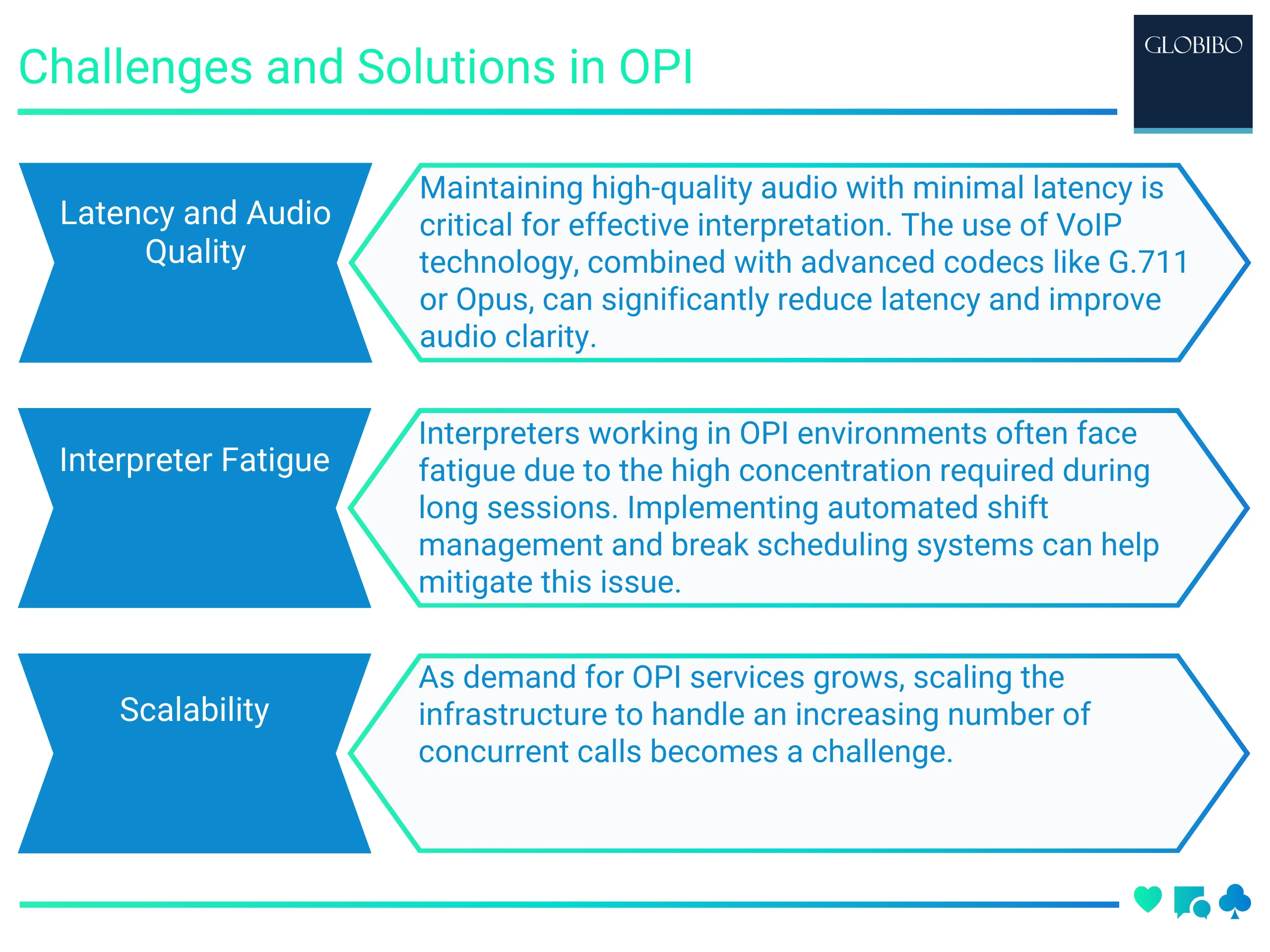
- Latency and Audio Quality: Maintaining high-quality audio with minimal latency is critical for effective interpretation. The use of VoIP technology, combined with advanced codecs like G.711 or Opus, can significantly reduce latency and improve audio clarity. Additionally, network monitoring tools are essential for detecting and addressing issues in real-time.
- Interpreter Fatigue: Interpreters working in OPI environments often face fatigue due to the high concentration required during long sessions. Implementing automated shift management and break scheduling systems can help mitigate this issue. Furthermore, real-time performance analytics can provide insights into interpreter workload, allowing for better resource allocation.
- Scalability: As demand for OPI services grows, scaling the infrastructure to handle an increasing number of concurrent calls becomes a challenge. Cloud-based solutions offer a scalable and flexible approach, allowing service providers to expand their capacity without significant upfront investment in hardware.
- Integration with Hybrid Interpretation: In a hybrid environment where OPI is combined with other interpreting modes, ensuring seamless integration is key. This involves developing APIs and middleware that can facilitate smooth transitions between different interpreting modes, whether it’s switching from phone to video or on-site services.
Hybrid Interpretation: Enhancing OPI
Hybrid Interpretation is an innovative approach that combines multiple interpreting modalities—such as OPI, VRI, and in-person interpreting—into a single, cohesive service offering. This approach provides flexibility and can cater to a wide range of client needs. Here’s how Hybrid Interpretation can enhance OPI:
- Versatility: Hybrid Interpretation allows clients to switch between different modes based on the situation’s requirements. For instance, a call may start as an OPI session and transition to VRI if visual cues are necessary for better communication.
- Improved Accessibility: By integrating various interpreting modes, Hybrid Interpretation can ensure that clients have access to interpretation services regardless of their location or available technology. This is particularly useful in regions with limited infrastructure, where OPI might be the only feasible option.
- Cost Efficiency: Hybrid Interpretation can optimize costs by utilizing the most appropriate mode for each situation. For example, using OPI for routine matters and reserving VRI or in-person services for more complex interactions can reduce overall expenses.
- Enhanced Continuity of Service: In cases where one mode fails—such as a video feed dropping in a VRI session—Hybrid Interpretation systems can seamlessly switch to another mode like OPI, ensuring uninterrupted service.
Key Advantages of OPI
- Accessibility: OPI provides access to interpretation services anytime and anywhere, making it ideal for emergencies and clients in remote locations.
- Cost-Effectiveness: Without the need for travel or specialized equipment, OPI is often more affordable than on-site interpreting services.
- Rapid Deployment: OPI services can be set up quickly, allowing clients to connect with interpreters within minutes, which is crucial in time-sensitive scenarios.
- Wide Language Availability: OPI platforms often offer a broad range of language pairs, accommodating diverse linguistic needs across different sectors.
- Scalability: OPI systems can easily scale to handle increased demand, making them suitable for organizations of all sizes.

Best Practices for Implementing OPI
- Invest in Reliable Telecommunication Infrastructure: Ensure that the network used for OPI services can support high-quality audio with minimal latency.
- Utilize Advanced Call Routing Systems: Implement IVR and other automated systems to efficiently route calls to the appropriate interpreters.
- Implement Security Measures: Adhere to industry standards for data encryption and user authentication to protect sensitive information.
- Provide Continuous Training for Interpreters: Offer ongoing professional development to ensure interpreters are up-to-date with the latest industry trends and technologies.
- Monitor Performance Metrics: Use real-time analytics to track interpreter performance and client satisfaction, allowing for continuous improvement of services.

Case Studies and Applications
Healthcare: In the healthcare sector, OPI is invaluable for facilitating communication between medical professionals and patients who speak different languages. For example, during a medical emergency, an OPI service can connect a non-English speaking patient with a healthcare provider in seconds, providing critical information that could be life-saving.
Legal Services: Legal professionals often rely on OPI to communicate with clients who do not speak the local language. OPI ensures that legal proceedings can continue without delay, helping to maintain the integrity of the judicial process.
Customer Support: Multinational companies use OPI to provide customer support in multiple languages, enhancing customer satisfaction and expanding their global reach.
Emergency Response: OPI is a critical tool for emergency response teams, allowing them to communicate effectively with individuals in crises where language barriers could hinder rescue efforts.
Future Trends in OPI
As technology continues to evolve, OPI is expected to incorporate more advanced features, such as artificial intelligence (AI) and machine learning (ML). These technologies could assist interpreters by suggesting translations, identifying context, and even predicting potential misunderstandings. Additionally, the integration of biometric authentication could enhance security measures, ensuring that only authorized users have access to sensitive conversations.
Furthermore, the rise of 5G networks will likely improve the quality of OPI services by providing faster and more reliable connections, particularly in remote areas. This will enhance the overall user experience, making OPI an even more attractive option for organizations worldwide. Remote simultaneous interpretation solutions for events can be complemented by OPI to ensure that all participants can access interpretation services.
Over-the-Phone Interpreting (OPI) Summary
Over-the-phone interpreting (OPI) is a vital service in today’s globalized world, offering a reliable and efficient means of communication across language barriers. By leveraging advanced telecommunications technology, secure infrastructure, and skilled interpreters, OPI enables organizations to connect with clients, patients, and customers from diverse linguistic backgrounds.
OPI can complement Remote Simultaneous Interpretation solutions for events, such as in governmental sessions, business meetings, and conferences. It also plays a significant role in facilitating interpretation for press conferences, where remote participation is often required.
The integration of Hybrid Interpretation further enhances the capabilities of OPI, providing a versatile and comprehensive solution that can adapt to various communication needs. As the demand for remote interpretation services continues to grow, OPI will remain a cornerstone of the language services industry, driven by technological innovation and a commitment to facilitating clear and accurate communication.
Academic References on Over-the-Phone Interpreting (OPI)
-
[PDF] PROBLEMS IN INTERPRETING
-
Utility of mobile technology in medical interpretation: A literature review of current practices
YouTube Video on Over-the-Phone Interpreting (OPI)

Susan Tan
Leadership Development Trainer
Susan has extensive experience in document localization for governmental and legal needs. Her work with embassies and government agencies ensures that documents meet specific regional requirements, making her expertise invaluable for international clients.