Legal Interpreting Services
Legal interpreting services support courts, law firms, legal departments, tribunals, immigration matters, depositions, negotiations, and other proceedings where participants do not share the same spoken or signed language. The service must preserve meaning, terminology, register, and procedural information across languages.
Globibo provides Language Services solutions with unrivaled speed, cost-efficiency, and quality to empower & engage People in Communication. For legal assignments, technology-driven processes and certified quality — only organization in Asia with ISO 17100 (Translation), ISO 18841 (Interpreting), and ISO 27001 (Information Security).
Legal Interpreting Overview
Legal interpreting is used when spoken or signed communication must be transferred between languages during a legal setting. Applications include court hearings, witness testimony, depositions, lawyer-client meetings, immigration proceedings, police interactions, tribunals, mediations, and legal negotiations.
The Singapore Courts provide a useful example of how court interpretation is structured. All court proceedings in Singapore are conducted in English. The current Singapore Courts guidance lists Mandarin, Hokkien, Teochew, Cantonese, Malay, Javanese, Boyanese, and Tamil among the languages and dialects provided by Supreme Court interpreters. Where the required language or dialect is not available, parties may need to engage a private or freelance interpreter.
Singapore Courts: Interpretation Services.

For Supreme Court criminal cases, Singapore Courts currently state that interpretation services are provided by the Court and are free of charge, although the required request procedure still applies. For civil and Family Division of the High Court matters, represented parties submit requests through their lawyer via eLitigation, while unrepresented parties can use the relevant request form. Current guidance states that requests should generally be submitted at least 7 working days before interpretation is required. Open court hearings in civil and Family Division matters carry a stated fee of $300 per day or part thereof, while chamber hearings are free of charge.

Private interpreters used in Supreme Court civil proceedings must also complete the required oath process before the Duty Registrar. The exact court procedure should always be checked against the latest Singapore Courts guidance because filing processes, fees, and administrative requirements can change.
Interpreting Modes
Legal proceedings use different interpreting modes depending on the communication event, speaking pattern, document type, and courtroom procedure. The Singapore Courts identify three modes used by court interpreters.
| Mode | Operational Method | Typical Legal Use |
|---|---|---|
| Simultaneous Interpretation | Interpretation is delivered almost concurrently with the speaker. | Court judgments and lawyer submissions where continuous delivery is required. |
| Consecutive Interpretation | The interpreter listens, may take notes, and interprets during pauses or after the speaker finishes. | Witness testimony, legal meetings, interviews, depositions, and negotiations. |
| Sight Interpretation | Written material is read in one language and rendered orally into another. | Affidavits, exhibits, forms, notices, and other legal documents requiring oral rendering. |
The appropriate mode should be determined before the proceeding rather than treating every legal assignment as a standard consecutive interpretation requirement.

Interpreting Mode Selection
Mode selection depends on the communication structure. Continuous submissions may require simultaneous interpretation, while witness questioning normally requires consecutive delivery so that the interpreter can render each statement after a pause. Document-based communication may require sight interpretation.
Before an assignment, legal teams should provide the language pair, hearing or meeting format, case type, expected duration, participant roles, relevant terminology, available documents, and any procedural instructions. Early preparation allows terminology and reference materials to be reviewed before the assignment.
For remote or hybrid proceedings, the technical environment must also be assessed. Audio quality, participant connectivity, microphone placement, interpreter monitoring, channel routing, and contingency arrangements can directly affect the interpreter’s ability to receive and render speech.
Technical Requirements of legal Interpretation
Legal interpreting requires a controlled communication path from the speaker to the interpreter and from the interpreter to the intended listener. Technical requirements vary according to whether the proceeding is onsite, remote, or hybrid.
| Requirement | Onsite Proceedings | Remote or Hybrid Proceedings |
|---|---|---|
| Audio Input | Dedicated microphones and controlled room audio. | Stable microphone input with controlled participant audio. |
| Interpreter Monitoring | Interpreter receives clear source audio and relevant visual information. | Interpreter requires reliable access to the remote audio and video feed. |
| Output | Receiver, headset, room audio, or dedicated interpretation channel. | Platform-based interpretation channel or controlled audio routing. |
| Contingency | Backup equipment and replacement communication paths. | Backup connectivity, device, audio, and interpreter communication procedures. |
Legal Interpretation ISO Standards
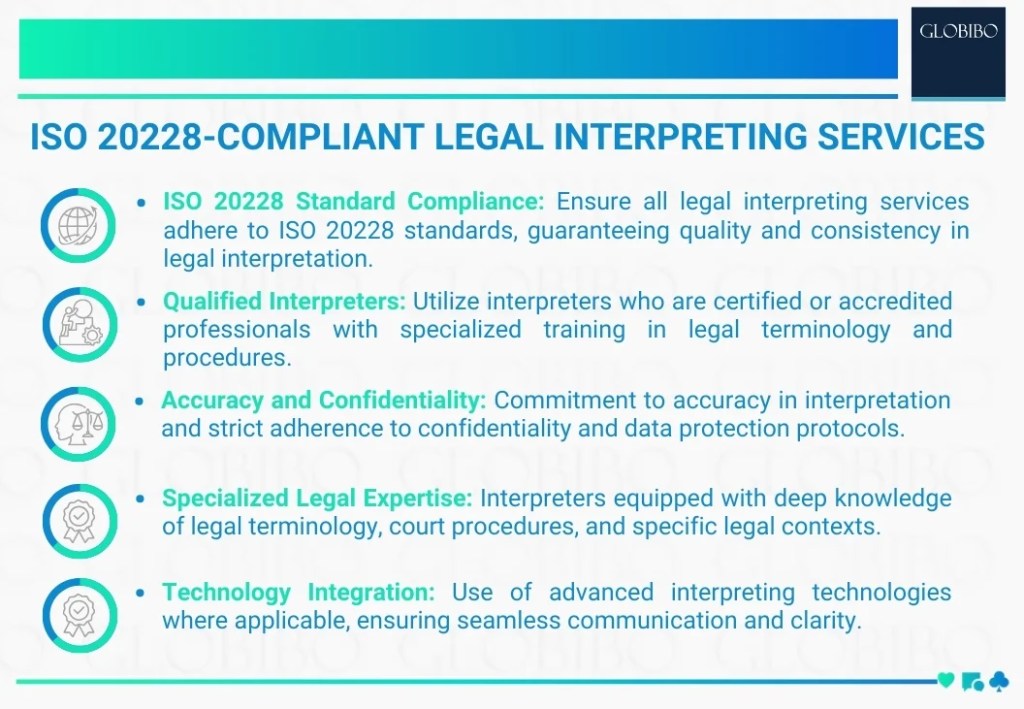
ISO 20228:2019 is the dedicated international standard for legal interpreting. It establishes basic principles and practices for legal interpreting, addresses interpreter competences, and describes legal settings and corresponding interpreting modes. ISO currently lists ISO 20228:2019 as published and under revision, with ISO/DIS 20228 as the draft second edition under development.
ISO 18841:2018 provides general requirements and recommendations for interpreting services. It functions as a broader interpreting-services reference, while specialized areas such as legal interpreting are addressed by standards including ISO 20228.
For simultaneous interpretation equipment, ISO 20109:2025 is the current published edition specifying requirements for equipment and the quality of sound and image transmitted to and from interpreters.
| Standard | Application | Status |
|---|---|---|
| ISO 20228:2019 | Legal interpreting requirements | Published; under revision |
| ISO 18841:2018 | General interpreting requirements and recommendations | Published; replacement under development |
| ISO 20109:2025 | Simultaneous interpreting equipment | Published |
| ISO 27001 | Information security management | Information security framework |
Legal Interpretation Case Studies
1. English–Telugu Court Interpretation in Hong Kong

Scope: Professional consecutive interpretation for a legal court session involving English and Telugu.
Challenge: The assignment involved legal proceedings requiring accurate handling of legal terminology, procedural communication, and language-specific requirements.
Solution: Globibo matched the assignment to an interpreter with the required English–Telugu language capability and legal knowledge. The assignment also included interpreting equipment and support for hybrid participation.
Result: The client received dedicated English–Telugu consecutive interpretation for the Hong Kong court session.
Read the English–Telugu Legal Interpretation Case Study
2. English–Japanese Interpretation for a Singapore Law Firm

Scope: Consecutive English–Japanese interpretation for a Singapore law firm.
Challenge: The law firm required language support while preparing for court cases and trials.
Solution: Globibo provided consecutive interpretation using subject-specific language support aligned with the legal context.
Result: The law firm received English–Japanese interpretation support for legal preparation.
Read the English–Japanese Legal Interpretation Case Study
3. Bengali Interpretation for a Singapore Law Firm

Scope: Consecutive Bengali interpretation for an award-winning Singapore law firm during work relating to a settlement agreement.
Challenge: The assignment required subject-specific communication in Bengali within a legal negotiation.
Solution: Globibo provided consecutive interpretation tailored to the legal context and language requirements.
Result: The law firm received Bengali interpretation support for communication surrounding the settlement agreement.
Read the Bengali Legal Interpretation Case Study
Consultation
Want to learn more? I ‘m looking forward to hearing from you!

Susan has extensive experience in conference interpretation, simultaneous interpretation services, document localization for governmental and legal needs. Her work with embassies and government agencies ensures that documents meet specific regional requirements, making her expertise invaluable for international clients.
Academic Research on Legal Interpreting Services
- New Technologies in the Court: Remote Hearings and Hybrid Interpreting During the Pandemic
— examines remote hearings, hybrid interpreting, court technology, and implications for fair trial requirements. - Ethics of Court Interpreters
— examines ethical conduct, impartiality, and professional practice in court interpreting. - US-Based Legal Interpreters and Their Use of Academic Research
— examines how legal interpreters use research and how professional practice can interact with academic work. - Manner Matters: Linguistic Equity Through a Court Interpreter in Australia
— examines linguistic equity and the importance of how courtroom speech is interpreted.
Key Articles on Legal Interpreting Services
- The Importance of Legal Interpreting in Criminal Cases
- Basic Principles of Legal Interpreting – ISO 20228
- Essential Qualifications for Legal Interpreters
- Reliable Legal Interpreting Services
- Expert Legal Interpreters for Court and Depositions
- Certified Legal Interpreting
- Why Certified Legal Interpreting Matters in Litigation
- Effective Legal Interpreting in Multilingual Legal Proceedings
- Legal Interpreting for Immigration Cases
FAQs on Legal Interpreting Services
1. What Is Legal Interpreting?
Legal interpreting is the oral or signed transfer of communication between languages in legal settings. It differs from legal translation, which concerns written content.
2. Which Interpreting Modes Are Used in Legal Proceedings?
Common modes include simultaneous interpretation, consecutive interpretation, and sight interpretation. The appropriate mode depends on the communication event, speaking pattern, document type, and procedural requirements.
3. What Is ISO 20228?
ISO 20228:2019 is the published international standard for legal interpreting. It establishes principles and practices for legal interpreting services, specifies interpreter competences, and addresses legal settings and corresponding interpreting modes. ISO/DIS 20228 is currently under development as the second edition and is intended to replace ISO 20228:2019.
ISO 20228:2019 |
ISO/DIS 20228.
4. Can Private Interpreters Be Used in Singapore Courts?
Yes. Singapore Courts state that private or freelance interpreters may be required when the required language or dialect is not provided by the relevant court or when no suitable court interpreter is available. For Supreme Court civil proceedings, private interpreters must complete the required oath process before the Duty Registrar.
5. How Early Should a Singapore Supreme Court Interpreter Be Requested?
Current Singapore Courts guidance states that interpretation requests for Supreme Court proceedings should generally be submitted no later than 7 working days before the interpreter is required. Specific procedures and deadlines vary according to the case type.
6. What Information Is Required for a Legal Interpreting Request?
Depending on the proceeding, the request may require the case number, parties, witnesses requiring interpretation, court or chamber number, proceeding stage, hearing date and time, number of interpretation days, and required language or dialect.
7. What Should Be Provided Before a Legal Interpretation Assignment?
Provide the language pair, jurisdiction, proceeding type, date, duration, location or remote format, interpretation mode, relevant terminology, and available case materials. Early access to reference material allows terminology and procedural requirements to be reviewed before the assignment.
8. Is Legal Interpreting Different From Legal Translation?
Yes. Legal interpreting transfers spoken or signed communication between languages during a live interaction, while legal translation converts written legal content from one language into another.
Contact Globibo for Legal Interpreting Services with your language requirements and proceeding details.