


Language Interpreters
Bridging Communication Gaps Across Cultures


 Language Interpreter
 Language Interpreter
Language Interpreters enable direct communication across languages in conferences, business meetings, government programs, medical events, legal settings, and multilingual gatherings. They convey spoken or signed information while preserving meaning, terminology, context, and language register.
Globibo provides Language Services solutions with unrivaled speed, cost-efficiency, and quality to empower & engage People in Communication. Request a Quote for interpreter requirements based on language pairs, interpreting mode, subject matter, participants, location, and event format.
Language Interpreter Overview
A Language Interpreter transfers spoken or signed communication from a source language into a target language. Unlike written translation, interpreting takes place during live communication and requires the interpreter to process speech, understand meaning and context, and produce the target-language message within the required timeframe.
The current Conference Interpretation source page identifies language interpreters as professionals who support communication across languages and cultures and highlights their use in business meetings, conferences, legal proceedings, healthcare settings, and multilingual events.
Interpreter Role
Professional interpreters do more than replace words from one language with words from another. They need to convey meaning, register, terminology, tone, and relevant cultural context while maintaining the communication flow.
For conference interpreting, this can involve processing spoken content in real time. For consecutive or liaison assignments, the interpreter may listen to a segment, take notes where necessary, and then reproduce the message in the target language.
Language & Cultural Expertise
Language proficiency needs to be supported by knowledge of the relevant cultural and communication context. Idioms, professional terminology, regional language variations, forms of address, and culturally specific references can affect how a message should be rendered.
The interpreter’s language combination should therefore be selected according to the actual communication requirement rather than language availability alone.
Assignment Preparation
Preparation can include agendas, presentation slides, speaker biographies, terminology lists, technical documentation, acronyms, previous event materials, and other subject-specific information.
Preparation becomes particularly important for medical, legal, financial, scientific, engineering, and technical assignments where terminology can materially affect the meaning of the discussion.
Language interpreters play a pivotal role in the field of conference interpretation, serving as the vital link between different languages and cultures. With their linguistic expertise and cultural understanding, they facilitate effective communication and ensure the success of international conferences, meetings, and other multilingual events. This article explores the significance of language interpreters in conference interpretation, their challenges, benefits, and the skills required to excel in this demanding profession.
Language interpreters are highly skilled professionals who facilitate communication between individuals who speak different languages. They possess a deep understanding of both the source and target languages, allowing them to accurately convey messages while preserving cultural nuances. Whether it’s in business meetings, conferences, legal proceedings, or healthcare settings, language interpreters ensure that all parties can effectively communicate and understand each other.
One of the primary responsibilities of language interpreters in conference interpretation is to provide accurate and real-time interpretation. They must possess a deep understanding of both the source and target languages to capture the nuances, tone, and context of the speaker’s message. Their ability to interpret on the spot, often in high-pressure situations, is crucial for maintaining the flow of communication and ensuring that participants can follow the proceedings seamlessly.
Please check out the following Language Interpreters:








Interpreter Expertise & Selection
Selecting a Language Interpreter involves more than identifying a person who speaks the required languages. The assignment should consider language direction, interpreting mode, subject matter, audience, event duration, communication environment, and the required level of specialization.
Language Proficiency
An interpreter needs sufficient command of the relevant source and target languages to understand spoken communication and reproduce it appropriately. Language combinations can include major international languages as well as regional languages and variants.
The current Conference Interpretation site lists Cantonese, Korean, Japanese, Mandarin, Malay, Indonesian, Thai, Vietnamese, German, French, Italian, and Spanish among its language options, alongside English and additional language coverage.
Subject Expertise
Subject knowledge is particularly important when interpreting specialized communication. A medical congress, legal proceeding, financial discussion, engineering presentation, or scientific conference can contain terminology that requires more than general conversational language skills.
Interpreter selection should therefore consider both language capability and the subject requirements of the assignment.
Terminology Preparation
Terminology preparation helps align interpreters with the client’s vocabulary before an assignment. This may include company names, product terminology, technical expressions, abbreviations, speaker names, project terminology, and industry-specific language.
For AI-supported interpretation, terminology can also be incorporated into the technology workflow. In Globibo’s large-scale interpretation deployment, AI engineers combined general and custom models to improve transcription and translation before and during the event.
Quality & Information Security
Globibo’s Language Services USP is technology-driven processes and certified quality — only organization in Asia with ISO 17100 (Translation), ISO 18841 (Interpreting), and ISO 27001 (Information Security).
ISO 18841:2018 establishes general requirements and recommendations for interpreting services. ISO currently has ISO/FDIS 18841, Edition 2, in the approval phase as the intended replacement for ISO 18841:2018.
For conference interpreting specifically, ISO 23155:2022 specifies requirements and recommendations for the provision of conference interpreting services.
Where simultaneous interpreting equipment is required, ISO 20109:2025 specifies requirements for equipment and the quality of sound and image transmitted to and from interpreters.
For permanent interpreting booths, ISO 17651-1:2024 provides requirements and recommendations for booth design, usability, and accessibility.
For interpreting hubs, ISO 17651-3:2026 specifies requirements and recommendations for their design, equipment, and operation.
Information security can also be relevant when interpreter workflows involve confidential meeting content, recordings, transcripts, or digital platforms. ISO/IEC 27001:2022 defines requirements for an information security management system.
Interpreting Modes & Delivery
The appropriate interpreting mode depends on how participants communicate, how quickly information must be rendered, group size, venue configuration, and whether the interpreter works onsite or remotely.
Simultaneous Interpreting
Simultaneous interpreting delivers the target-language message while the speaker continues speaking. It is commonly used for conferences, congresses, large meetings, and multilingual events where participants need continuous access to spoken content.
The interpreter typically works from an interpreting booth or approved interpreting environment and uses an interpreter console to receive the source audio and transmit the interpreted channel.
Consecutive Interpreting
Consecutive interpreting involves the speaker pausing so the interpreter can render the preceding message. It is commonly suited to meetings, presentations involving smaller groups, interviews, visits, and situations where direct interaction is important.
The interpreter may use structured note-taking for longer segments.
Liaison Interpreting
Liaison interpreting supports two-way communication between participants, often in smaller meetings, site visits, consultations, negotiations, and interviews. The interpreter works between the participants as the conversation develops.
This mode is particularly relevant when communication depends on questions, responses, clarification, and direct interaction rather than continuous audience delivery.
Remote & Hybrid Interpreting
Remote interpreting can connect interpreters to participants through digital platforms. Hybrid configurations can combine onsite conference equipment, remote interpreters, streaming infrastructure, and attendee-facing digital channels.
Globibo’s Australia case demonstrates this type of architecture, with Events.Studio operating as an interpretation hub across multiple venues alongside human interpreters and AI-supported translation. The project involved 5,000 participants, 26 linguists, and 40 sessions.
Conference Equipment
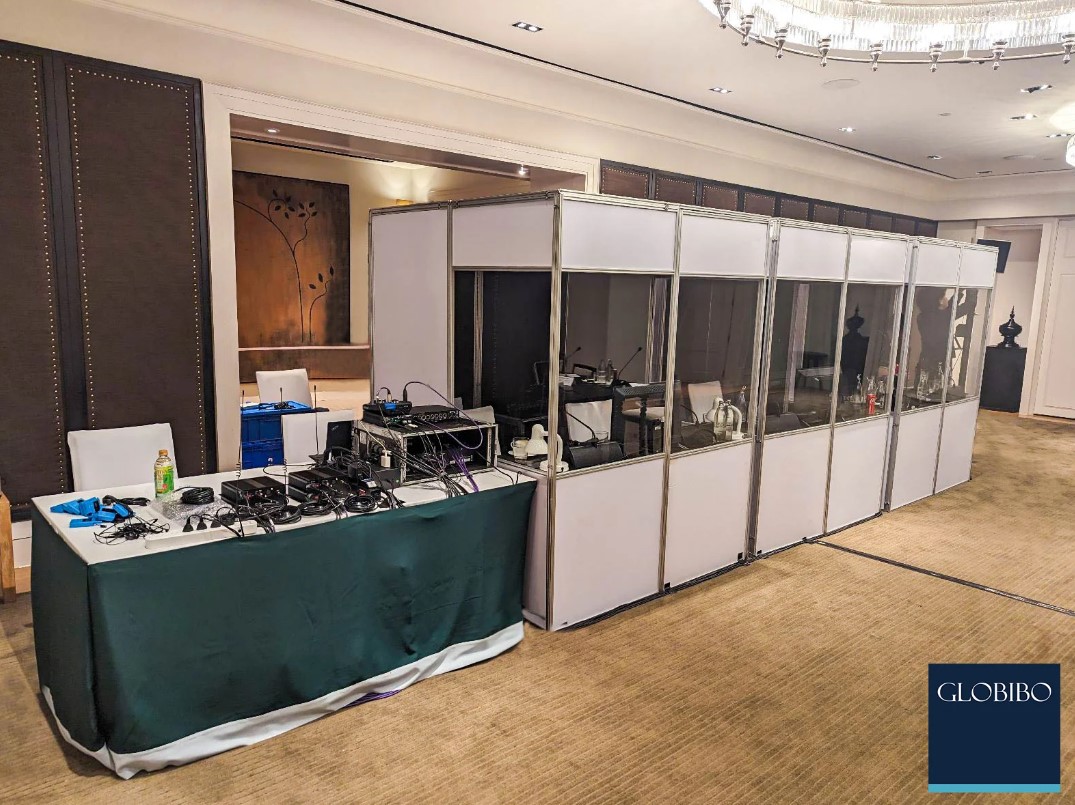
Large-scale simultaneous interpreting can require booths, interpreter consoles, central control units, audio mixers, transmitters, receivers, microphones, monitoring systems, and appropriate signal distribution.
ISO 20109:2025 provides current requirements for simultaneous interpreting equipment and the quality of sound and image transmitted to interpreters and audiences.
Language Interpreter Applications
Language Interpreters can support communication across commercial, institutional, technical, medical, legal, academic, and public-sector environments.
Conferences & Events
International conferences frequently require simultaneous interpretation across several language combinations. The configuration may include interpreter teams, booths, consoles, receivers, audio infrastructure, remote interpretation, or digital delivery.
For larger programs, interpreter scheduling and technical coordination become part of the operational design.
Business Meetings
Business meetings, negotiations, executive discussions, supplier meetings, and international delegations may require consecutive or liaison interpreting. The interpreter needs to maintain the meaning and intent of the discussion while supporting direct communication between participants.
Legal & Government
Legal and government assignments can involve specialized terminology, procedural requirements, confidentiality, and formal communication. ISO 20228:2019 establishes principles, practices, and competence requirements for legal interpreting; ISO is currently developing a second edition, ISO/DIS 20228, which is under development.
Medical & Technical
Medical and technical interpreting requires preparation around terminology and subject matter. The Vietnam medical case supplied for this page demonstrates a hybrid interpretation environment combining human expertise and AI-supported technology for specialized medical communication.
For a medical association’s 3-day hybrid program in Singapore, Globibo delivered AI simultaneous interpretation for English, Korean, and Japanese, using a medical-specialized model, speaker diarization, language detection, speaker tagging, and onsite technical support. The case reported 98% positive feedback.



Interpretation Case Studies
Globibo’s project experience includes multilingual media programs, large-scale interpretation deployments, and specialized medical events.

Korea Media Gathering
Scope: 150 participants, including 120 media professionals and 30 staff, over 2 days.
Challenge: The global media program required multiple language directions and interpretation infrastructure.
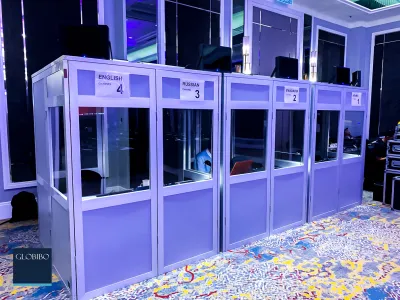
Solution: Globibo provided 7 conference interpretation booths, 7 digital interpreter consoles, a central control unit, audio mixer, 5 FM transmitters, 150 FM receivers, and 4 on-site engineers. Interpretation covered English, Korean, Mandarin, Cantonese, and Thai across 7 language pairs.
Result: The configuration supported multilingual briefings and discussions for the participating media professionals.

Singapore Multilingual Event
Scope: 2,800 participants over 6 days with 28 linguists.
Challenge: The program required large-scale interpretation infrastructure and distribution to thousands of participants.
Solution: The setup included 14 conference interpretation booths, 28 interpreter consoles, 14 interpreter transmitters, 8 mobile interpretation transmitters, 2,800 receivers, audio recording infrastructure, and AI interpreter assistance.
Result: The interpretation infrastructure was tested before each event day, with dedicated teams supporting AV operations, receivers, and AI technology throughout the program.

Vietnam Medical Event
Scope: 50 participants over 2.5 days for an ophthalmology lecture.
Challenge: The program required specialized Vietnamese-English communication while providing additional language access for Southeast Asian participants.
Solution: Globibo combined human interpreters for Vietnamese-English with AI interpretation for additional languages. The setup included interpretation booths, interpreter consoles, transmitters, receivers, speaker diarization, language detection, speaker tagging, and on-site technical support.
Result: The combined approach supported medical discussions and additional language access through participant devices. The case study reports 98% feedback.
Speak with Experts

Susan has extensive experience in conference interpretation, simultaneous interpretation, and Consecutive Interpretation services, document localization for governmental and legal needs. Her work with embassies and government agencies ensures that documents meet specific regional requirements, making her expertise invaluable for international clients.
YouTube Videos on Language Interpreters
FAQs on Language Interpreters
1. What does a Language Interpreter do?
A Language Interpreter conveys spoken or signed information from one language into another while preserving the meaning, context, and relevant language register of the original communication.
2. What is the difference between a Language Interpreter and a Translator?
An interpreter works primarily with spoken or signed communication during live interaction, while a translator works with written content. The current ISO draft for interpreting explicitly distinguishes interpreting from translation on this basis.
3. Which interpreting mode should I choose?
The choice depends on the communication format. Simultaneous interpreting suits conferences and large audiences, consecutive interpreting suits meetings and presentations with pauses, and liaison interpreting suits direct two-way communication.
4. Can Language Interpreters handle technical subjects?
Yes. Specialist assignments should be staffed according to both language capability and subject requirements. Terminology lists, presentations, technical documents, and other preparation materials can help interpreters prepare for specialized communication.
5. How many Language Interpreters does a conference need?
There is no universal number. Requirements depend on language combinations, session duration, interpreting mode, number of parallel sessions, workload, and interpreter working conditions.
6. Can interpreters work remotely?
Yes. Remote interpreting can connect interpreters with physical, virtual, or hybrid events through suitable platforms and technical infrastructure. Large deployments may combine remote interpreters with onsite interpretation equipment.
7. Are Language Interpreters relevant for medical events?
Yes. Medical interpreting requires attention to specialized terminology and communication requirements. The supplied Globibo medical case demonstrates the use of specialized language processing and interpretation technology in a medical-event environment.
8. What information is needed to arrange Language Interpreters?
Useful information includes language pairs, dates, location, event type, participant numbers, session duration, subject matter, interpreting mode, number of parallel sessions, and available presentation or terminology materials.
Academic References on Language Interpreter
- Seeber, K. G. (2011). “Cognitive load in simultaneous interpreting: Existing models—new perspectives.” Interpreting, 13(2), 176–204. This research examines cognitive load in simultaneous interpreting.
- Gile, D. (2009). Basic Concepts and Models for Interpreter and Translator Training. John Benjamins. The work provides theoretical models for interpreting effort and training.
- ISO 23155:2022. Interpreting services — Conference interpreting — Requirements and recommendations. This is the current published ISO standard specifically addressing conference interpreting.
- ISO 20109:2025. Simultaneous interpreting — Equipment — Requirements. This current standard addresses simultaneous interpreting equipment and transmitted sound and image quality.
- ISO 17651-3:2026. Simultaneous interpreting — Interpreters’ working environment — Part 3: Requirements and recommendations for interpreting hubs. This current standard addresses interpreting hub design, equipment, and operation.
