


Interpretation Consoles
Choosing the Right Interpretation Console Provider


 Interpretation Consoles
 Interpretation Consoles
Interpretation consoles are a crucial component of interpretation equipment, enabling interpreters to deliver simultaneous interpretation in multilingual conferences and events. These consoles offer advanced features and functionalities that enhance the accuracy, control, and efficiency of interpretation. We will explore two types of interpretation consoles: hard and soft consoles. We will also discuss the importance of network integration and live-stream integration in interpretation systems, highlighting their technical aspects and benefits.
The equipment that interpreters use to listen to one or more audio language inputs and deliver the interpretation into a microphone is called an interpreter console. To provide the interpretation to those who have interpretation receivers, this microphone is connected to control units and transmitters. The various features of the interpretation consoles, including selecting the input channel, muting the transmission, and altering the audio volume, are designed to increase the interpreter’s productivity and comfort. Some venues prefer wired in-built interpretation systems, which can be connected directly to interpretation consoles for a seamless operation.
This section Includes:










Hard Console
01
Hard Consoles:
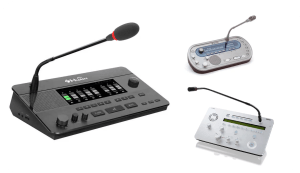
Hard interpretation consoles are physical devices specifically designed for professional interpreters. These consoles are equipped with a range of controls and features that facilitate interpretation tasks. Key technical aspects of hard consoles include:
- Channel Selection: Hard consoles allow interpreters to select specific channels for receiving the audio feed in different languages.
- Volume Control: Interpreters can adjust the volume levels of incoming audio and their own interpretation output.
- Language Switching: Hard consoles enable interpreters to switch between different languages effortlessly during interpretation sessions.
- Microphone Integration: Consoles often have built-in microphone inputs, allowing interpreters to use dedicated microphones for clear and precise communication.
- Headset Connection: Interpreters can connect their headsets to the console, enabling them to listen to the audio feed and deliver interpretation without any disruptions
Interpretation Consoles

Soft Console
02
Soft Consoles:
Soft interpretation consoles, also known as software-based consoles, provide a virtual interpretation interface on a computer or tablet. These consoles offer similar functionalities to hard consoles but in a digital format. Technical aspects of soft consoles include:
- User-Friendly Interface: Soft consoles feature intuitive interfaces that allow interpreters to control interpretation settings easily.
- Customization Options: Interpreters can personalize the console layout, language settings, and other preferences to suit their needs.
- Mobility: Soft consoles provide flexibility as they can be installed on portable devices, allowing interpreters to work from anywhere within the conference venue.
- Integration with Interpretation Platforms: Soft consoles can be seamlessly integrated with interpretation platforms, enabling interpreters to access audio feeds, interact with colleagues, and manage interpretation assignments efficiently.
Interpretation Consoles

Network Integration
03
Network integration is a crucial aspect of interpretation consoles, as it allows for smooth communication and coordination among interpreters and technicians. Here are the key technical aspects of network integration:
- Centralized Control: Interpretation consoles can be connected to a central control unit, allowing technicians to monitor and manage the interpretation system.
- Intercom Functionality: Network integration enables interpreters to communicate with technicians and colleagues through intercom systems, ensuring effective coordination.
- Real-time Data Exchange: Through network integration, consoles can exchange real-time data, such as interpretation channel assignments and system status, ensuring accurate and synchronized interpretation delivery.
Interpretation Consoles

Live-Stream Integration
04
In today’s digital age, live-streaming of conferences and events has become increasingly common. Integration of interpretation consoles with live-streaming platforms offers several technical benefits:
- Audio Embedding: Interpretation consoles can embed interpretation audio directly into the live-streaming feed, allowing remote participants to listen to the interpreted content in real-time.
- Multiple Language Streams: With live-stream integration, consoles can provide separate language streams for different target audiences, ensuring an inclusive and accessible experience for all participants.
- Compatibility with Live-Stream Platforms: Interpretation consoles are designed to work seamlessly with popular live-streaming platforms, enabling hassle-free integration and smooth broadcasting of interpreted content.
Our fundamental infrastructure consists of things like interpreting consoles, transmitters, and radiators, the full cabling system, as well as security components, in addition to interpretation booths, microphones, speakers, and headsets. We make certain that the system can offer you the greatest simultaneous interpreter, technology, and specialists to oversee every detail of your event.
Interpretation Consoles
The Brahler Digital DigiMic DDol 32

DIGIMIC’s DDol 32 digital Interpreter Console supports up to 32 audio channels (OR + 31 languages) and one interpreter. Its straightforward layout, wide, vivid display, and lit buttons provide simple, intuitive use. Equally self-explanatory are the up to three configurable output channels and the five pre-selected monitoring languages. The technical team or the chairperson has access to additional distinct call channels. All standard (mono and stereo) headphones may be attached to the console with ease, and when used with different types of microphones or integrated headsets, they ensure the interpreter’s maximum comfort. Three components make up the interpreter console:
Listening and relay section
- 5 pre-selected relay channels in the listening and relay area, separate floor button
- Quality indicator for relay interpretation
Tech Information
- Complies with IEC 914 and IEC 2603 standards.A 2 OR plus 31 channels
- 48 kHz sample rate
- Dimensions 24 BIT
- Response to frequency: 20–20,000 Hz
- LC-Display with an end-to-end latency of 1.5 ms, 2 × 56 characters, and backlight
- (D9) for interconnection: PRIOR
- NEXT (D9) is for connecting.
- Lockable microphones TM58/6 or TMD01 (Minicon socket)
- headphone jacks (3.5/6.3 mm)
- 8-pin socket for Electret Headsets (DIN)
- Housing strong plastic, black, lower portion
- Housing Aluminum operation panel with “silver” anodizing
- (305 x 96 x 175) mm, WxHxD
- Size: 1.5 kilogram
- Assurances: CE (Europe)
Monitoring section
- A Channel-selectable loudspeaker that can hear all languages
- When a DDol 32 in the booth becomes live, all loudspeakers within one pair will be instantly muted.
Speaking part
- Three exit channels (A, B, and C)
- On/Off switch for the microphone
- Press the mute button to momentarily silence the active microphone.
- A clear indicator of channels that are occupied and active
Additional Features
- Call for the operator or the chair
- Auto Floor, Auto Relay
- Different takeover modes with configurable “Hearing guard” LEDs to warn of excessive headphone volume
Interpreter console for Brahler Dol7 Interpreter Console DOL7

Interpreter Console DOL7/2 is made to transmit 1+6 channels in 6 different languages. With the use of fixed-mounted A36 connection cables, DOL7/2 is connected to the control console and the following interpreter console using single-cable technology. Monitoring, speaking, and special functions are the three clearly separated, function-oriented portions of the control panel.
The controls are simple to use and have a user-friendly design. The 6-digit rotary switch can be used to preselect an interpretation channel through the two “Monitoring” function areas. Using the RELAIS toggle switch, the interpreter can select between this interpretation channel and the ORIGINAL (floor) channel. Separate controls allow you to individually adjust the volume, bass, and treble.
Salient features:
- Two interpreters’ control panel
- 1+6 channels work with 1+8 channel equipment and older control consoles
- utilizing single-cable technology for connectivity
- choosing the incoming channels A, B, and C
- CALL channel for processor-controlled internal communications
- displaying the ISO639-compliant output channel and language HEARING GUARD (Protect your hearing!)
- programming switch to set up the channels that go out
- As an additional choice: ChipCard reader for storing and reading the DOL interpreter console’s configuration
Tech Information
- Meeting IEC914 and DIN56924 requirements, the “Booths for simultaneous interpretation” feature.
- A36K plug standard
- Permanent connection of A36K standard socket and 3.5m cable.
- 2 K2-CN sockets for 6.5mm jack-equipped headphones
- 2 sockets for D7-CB connectors on headphones/headsets
- 2 sockets for D5-BS connectors on electret microphones TM55/18
- Processor-controlled with switch for multiple console connection
- Limiter-equipped microphone pre-amplifier
- Balanced output +6dBV, frequency response 125Hz–15kHz
- S/N ratio >60dB(A), distortion factor 1%
- LC-Display for channel, language, and status
- Separate controls for bass, treble, and volume on headphone monitor amplifier
- Frequency response 100 Hz to 20 kHz, S/N ratio >70 dB(A), distortion factor 0.5%
- HEARING GUARD with optical warning
- CALL channel for outside speakers
- Three locking modes for the outgoing channel
- Sturdy black plastic housing, aluminum control panel (306×40/98x187mm)
- 21.5° slope, weight: 1.9 kilograms (including cable)
-

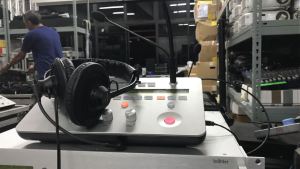
Interpreter Consoles DDol32 in warehouse
-
Digital Interpretation Console, Brahler DDol32
-
Digital Interpretation Console, Brahler DDol32
-
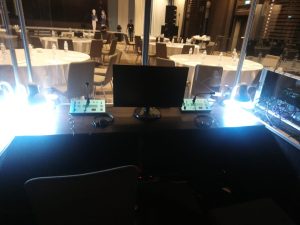
Digital Interpretation Console in Interpreter Booth, Brahler DDol32
-
Interpretation Consoles
-
Digital Interpretation Channel Monitoring
-
Interpreter Booths, Consoles in Action
-
Interpretation Equipment on the move
-
William Sound Interpreter Consoles
-

Conference Equipment
-
Digital Interpretation system, braehler Digimic and Yamaha Tio 1608, FCBC
-
Braehler Dol7 Dual-Interpreter Console






YouTube Video on Interpretation Consoles
FAQs
How does an interpreter console work?
How does an interpreter console work?
The interpreter console typically consists of a microphone, headphones, and a control unit. The interpreter listens to the speaker through headphones, translates the message, and speaks into the microphone to relay the translated message to the audience. The console often has features like channel selection and volume control for ease of use.
What are the key features of an interpreter console?
What are the key features of an interpreter console?
Interpreter consoles often include features such as multiple language channel support, individual volume controls, high-quality sound, and ergonomic design for the comfort of interpreters. They may also have additional functionalities like mute options, integrated loudspeakers, and advanced controls for efficient interpretation.
Can interpreter consoles support multiple languages simultaneously?
Can interpreter consoles support multiple languages simultaneously?
Yes, most interpreter consoles are designed to support multiple language channels simultaneously. This allows for real-time interpretation in multiple languages during a conference or event, catering to a diverse audience.
Are interpreter consoles easy to set up and operate?
Are interpreter consoles easy to set up and operate?
Interpreter consoles are designed to be user-friendly and easy to set up. They typically come with clear user manuals and guidelines for quick installation and operation. Manufacturers often provide training and support to ensure smooth usage.
What types of events require interpreter consoles?
What types of events require interpreter consoles?
Interpreter consoles are essential for multilingual events, conferences, seminars, business meetings, international summits, and any gathering where participants speak different languages. They facilitate effective communication and ensure that all attendees can comprehend the content in their preferred language.
Do interpreter consoles have compatibility requirements?
Do interpreter consoles have compatibility requirements?
Interpreter consoles may have compatibility requirements with the overall sound system of the venue. It’s important to ensure that the console can integrate seamlessly with the existing audio setup to guarantee optimal functionality and performance.
Can interpreter consoles be customized to specific event needs?
Can interpreter consoles be customized to specific event needs?
Yes, interpreter consoles can often be customized to meet the specific requirements of an event. This may include configuring the system for a particular number of languages, adjusting microphone sensitivity, or tailoring the design to match the event’s aesthetic.
For further assistance or inquiries about interpreter consoles and their applications, please contact us.

Susan Tan
Leadership Development Trainer
Susan has extensive experience in document localization for governmental and legal needs. Her work with embassies and government agencies ensures that documents meet specific regional requirements, making her expertise invaluable for international clients.
