Legal Interpreter Certification and Training Programs
Legal interpreting is essential for ensuring justice and effective communication in legal proceedings. Legal interpreters play a pivotal role in bridging language gaps, allowing all parties involved to understand and participate fully in legal processes. Given the critical nature of their work, interpreters must undergo rigorous certification and training to perform their roles accurately and ethically. This article explores certification and training programs for legal interpreters, including best practices aligned with ISO standards.
Importance of Certification and Training in Legal Interpreting
Legal interpreters are crucial in various legal settings, including courts, arbitration panels, and legal consultations. The legal interpreter’s role is vital for ensuring that all parties can understand and engage in legal proceedings effectively. Rigorous certification and training are essential to ensure that interpreters possess the necessary skills and knowledge.

Legal Interpreting Services: A Crucial Role
Legal interpreting services ensure that individuals with limited English proficiency receive fair treatment within the legal system. Interpreters must accurately convey legal concepts, client testimonies, and procedural details. For a deeper understanding of the importance of legal interpreting in different contexts, refer to Legal Interpreting for Civil Litigation and The Importance of Legal Interpreting in Criminal Cases.
Certification and Training Requirements
Certification and training programs are designed to address the various competencies required for effective legal interpreting. These programs typically include:
- Language Proficiency: Mastery of both source and target languages is essential for accurate interpretation. Interpreters must be able to handle complex legal terminology and nuances.
- Legal Terminology: Understanding specialized legal vocabulary and concepts is crucial for interpreting accurately in legal contexts.
- Ethics and Professionalism: Adherence to ethical guidelines and professional standards is vital for maintaining the integrity of legal interpreting services.
- Interpreting Techniques: Knowledge of consecutive and simultaneous interpreting techniques is necessary for effective communication.
- Cultural Competence: Awareness of cultural differences and their impact on communication is important for providing accurate interpretations.
Certification Programs for Legal Interpreters
Certification programs validate an interpreter’s competence and ensure adherence to industry standards. These programs may vary in scope, duration, and content, depending on the certifying body and regional requirements.
Key Certification Programs
Several organizations offer certification for legal interpreters:
- American Translators Association (ATA): The ATA provides certification through a rigorous examination process that tests language proficiency and legal terminology. This certification is widely recognized in the translation and interpreting fields.
- National Association of Judiciary Interpreters and Translators (NAJIT): NAJIT offers certification specifically for court interpreters and translators, focusing on skills needed for judicial settings. For further details, see Competence and Qualification of Legal Interpreters.
- Federal Court Interpreter Certification Examination (FCICE): Administered by the Administrative Office of the U.S. Courts, the FCICE certification is tailored for federal court interpreters and assesses skills relevant to federal legal contexts.
- International Association of Conference Interpreters (AIIC): AIIC certification is globally recognized and involves a comprehensive evaluation of interpreting skills, including both consecutive and simultaneous modes. This certification is important for conference settings. For more on interpreting modes, refer to Types/Recommendations of Legal Interpreting Mode.
Certification Process
The certification process typically involves several steps:
- Application: Submission of an application, including proof of language proficiency and educational background.
- Examination: Completion of written and oral exams that assess language skills, legal knowledge, and interpreting techniques. Exams often include practical scenarios relevant to legal interpreting.
- Ethics Training: Completion of coursework or training on professional ethics and standards. This training covers confidentiality, impartiality, and other ethical considerations.
- Practical Experience: Demonstration of interpreting experience through internships, practicums, or practical assignments.
List of Certification Requirements
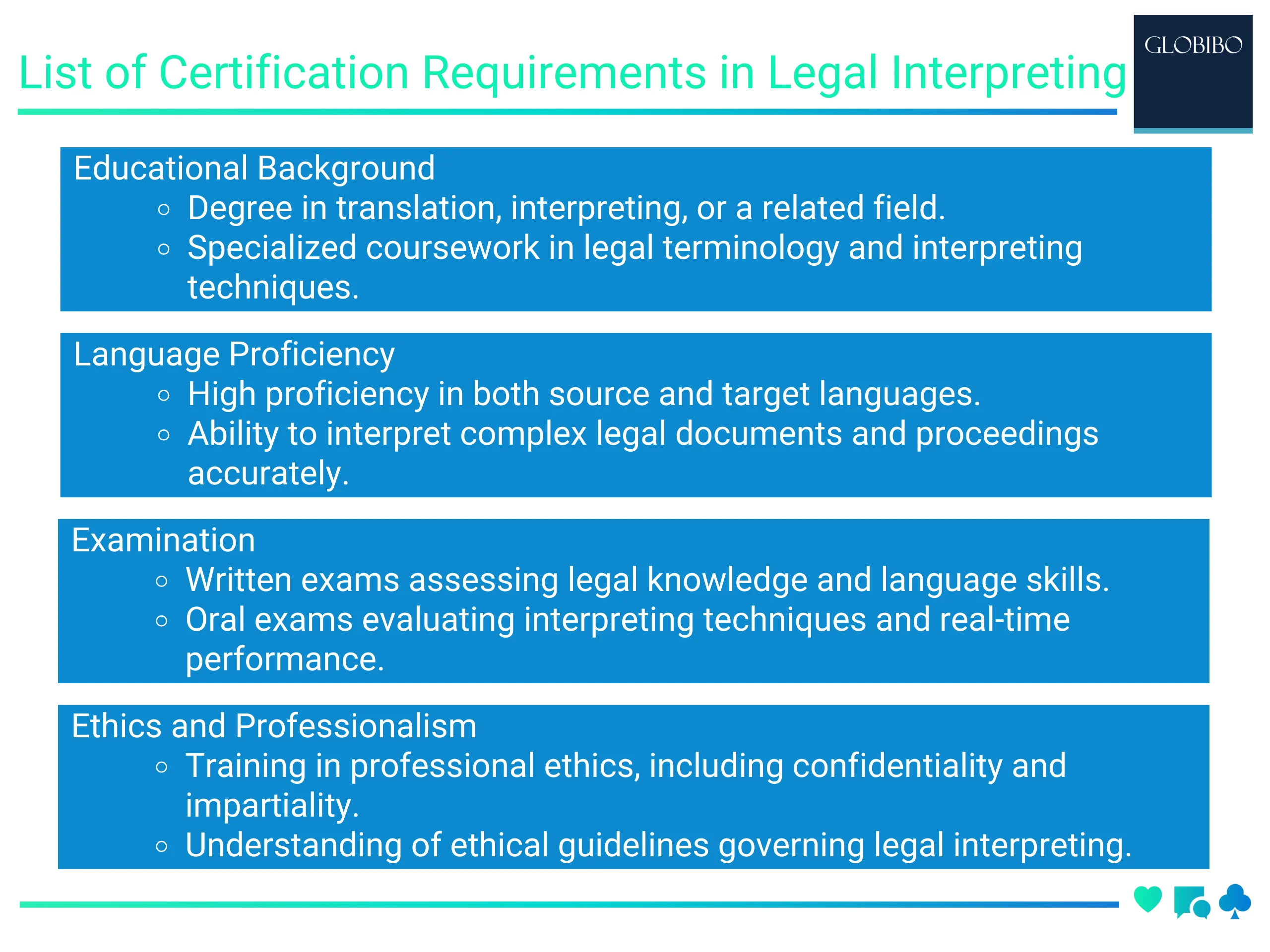
Here is a list of common certification requirements:
- Educational Background
- Degree in translation, interpreting, or a related field.
- Specialized coursework in legal terminology and interpreting techniques.
- Language Proficiency
- High proficiency in both source and target languages.
- Ability to interpret complex legal documents and proceedings accurately.
- Examination
- Written exams assessing legal knowledge and language skills.
- Oral exams evaluating interpreting techniques and real-time performance.
- Ethics and Professionalism
- Training in professional ethics, including confidentiality and impartiality.
- Understanding of ethical guidelines governing legal interpreting.
- Experience
- Practical interpreting experience, including internships or assignments in legal settings.
Training Programs for Legal Interpreters
Training programs provide the foundational skills and knowledge needed for effective legal interpreting. These programs are offered by educational institutions, professional organizations, and online platforms.
Components of Training Programs
Training programs typically include the following components:
- Legal Terminology: Detailed instruction on legal terms, their usage, and context in various legal settings. This component is critical for ensuring accurate interpretation of legal documents and proceedings. For more information, see Basic Principles of Legal Interpreting.
- Interpreting Techniques: Training in both consecutive and simultaneous interpreting methods, including the use of interpreting equipment. This ensures interpreters can handle different types of interpreting tasks effectively.
- Cultural Competence: Education on cultural differences and their impact on interpreting. This includes understanding cultural nuances and addressing potential biases. For insights on cross-cultural aspects, refer to Cross-Cultural Communication in Legal Interpreting.
- Ethics and Standards: Guidance on ethical practices and professional standards, including case studies on ethical dilemmas. This training helps interpreters maintain professionalism and integrity in their work.

List of Training Components
Here is a structured list of essential training components:
- Legal Terminology
- Study of legal concepts and terminology used in different legal systems.
- Exercises in translating and interpreting legal documents, such as statutes and contracts.
- Interpreting Techniques
- Training in consecutive interpreting, including note-taking and memory techniques.
- Training in simultaneous interpreting, including the use of headsets and microphones.
- Cultural Competence
- Exploration of cultural differences and their impact on communication.
- Training on handling cultural biases and promoting inclusivity.
- Ethics and Standards
- Instruction on the code of ethics for legal interpreters.
- Case studies on ethical issues and professional conduct.
- Practical Experience
- Hands-on practice through simulated legal scenarios and role-playing exercises.
- Supervised interpreting assignments in real or simulated legal contexts.

ISO Standards and Best Practices
ISO standards help ensure the quality and consistency of legal interpreting services. Relevant standards include:
- ISO 17100:2015: This standard specifies requirements for translation services, including aspects related to interpreting. It covers interpreter qualifications, resources, and project management.
- ISO 9001:2015: This standard focuses on quality management systems. Applying it to interpreting services ensures consistent quality and continuous improvement. It is important to maintain high standards in legal interpreting services.
- ISO/IEC 27001:2013: This standard pertains to information security management. It is crucial for protecting confidentiality and ensuring data security in legal interpreting services. For a related topic on security, see Legal Interpreting Services for Immigration Cases.
Key ISO Standards
Here is a table summarizing relevant ISO standards for legal interpreting services:
| ISO Standard | Description | Relevance to Legal Interpreting |
|---|---|---|
| ISO 17100:2015 | Requirements for translation services | Ensures interpreter qualifications and service quality |
| ISO 9001:2015 | Quality management systems | Ensures consistent quality in interpreting services |
| ISO/IEC 27001:2013 | Information security management | Protects confidentiality and data security |
Legal Interpreter Certification and Training Programs Summary
Legal interpreter certification and training programs are vital for ensuring high-quality legal interpreting services. These programs provide interpreters with the skills and knowledge needed to handle complex legal language and procedures effectively. By adhering to certification requirements and training standards, legal interpreters can uphold the integrity of legal proceedings and ensure fair representation for all parties involved.
Academic References On Legal Interpreter Certification and Training Programs
-
[BOOK] Assessing legal interpreter quality through testing and certification: The Qualitas Project
-
Training and certification of court interpreters in a multicultural society
-
A case for training signed language interpreters for legal specialization
-
A cross-national Overview of translator and interpreter certification procedures
-
Court interpreters: standards of practice and standards for training
-
Understanding legal interpreter and translator training in times of change
-
Interpreting in the gray zone: Where community and legal interpreting intersect
YouTube video on Legal Interpreter Certification and Training Programs

Susan Tan
Leadership Development Trainer
Susan has extensive experience in document localization for governmental and legal needs. Her work with embassies and government agencies ensures that documents meet specific regional requirements, making her expertise invaluable for international clients.