Choosing the right Interpreting Booth for your event
Multilingual events rely on seamless communication to connect participants from diverse linguistic backgrounds. Interpreting booths play a crucial role in enabling interpreters to deliver accurate and efficient translations. Whether you’re planning a conference, corporate seminar, or cultural symposium, choosing the right interpreting booths is vital for ensuring a professional and productive event.
This guide explores the types of interpreting booths, the factors to consider when selecting them, and how they enhance interpreter performance and attendee experience. By understanding the features and requirements of interpreting booths, you can make informed decisions that contribute to the success of your event.
Why Interpreting Booths are essential
Modern interpreting booths provide interpreters with a dedicated, soundproofed environment where they can work without distractions. This controlled space is vital for ensuring that interpreters can focus on delivering precise and clear communication, free from external noise or interruptions.
Key benefits of Interpreting Booths:

- Noise isolation: High-quality soundproofing minimizes external interference, enhancing interpreter concentration.
- Professional setup: Equipped with advanced tools such as microphones, headsets, and visual aids, booths ensure interpreters can perform efficiently.
- Event enhancement: Clear and uninterrupted translations improve communication, fostering collaboration among participants.
Investing in the right interpretation booths reflects a commitment to excellence, setting the stage for a successful multilingual event.
Types of Interpreting Booths

Choosing the correct interpreting booth depends on your event’s size, nature, and logistical requirements. Below are the most common types, each suited to specific scenarios.
1. Permanent Interpreting Booths
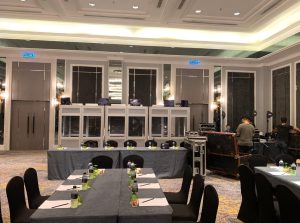 Permanent interpreting booths are designed as fixed installations in venues that regularly host multilingual events.
Features of permanent Interpreting Booths:
- Superior sound insulation: Built with high-grade materials for excellent noise reduction.
- Integrated equipment: Includes fixed audio systems, climate control, and ergonomic seating.
- Custom designs: Tailored to meet the venue’s functional and aesthetic needs.
Best suited for:
Large venues such as convention centers, auditoriums, and government institutions that frequently host international events.
2. Temporary Interpreting Booths
Temporary interpreting booths are portable and easy to assemble, making them ideal for events held in venues without permanent facilities.
Features of Temporary Booths:
- Flexibility: Adaptable to different event layouts and participant capacities.
- Quick assembly: Can be set up and dismantled efficiently.
- Cost-effective: Suitable for short-term or one-off events.
Best suited for:
Hotel ballrooms, pop-up conferences, and rented event spaces.
3. Table-top Interpreting Booths
Table-top booths are compact and lightweight, designed for small events with limited space.
Features of table-top booths:
- Portable design: Easily transported and assembled on standard tables.
- Space-efficient: Takes up minimal room while providing essential soundproofing.
- Convenience: Suitable for informal or small-scale gatherings.
Best suited for:
Workshops, breakout sessions, and intimate meetings.
4. Conference Interpreting Cabins
Conference cabins offer a premium experience for interpreters, providing the highest level of comfort and sound isolation.
Features of conference cabins:
- Advanced soundproofing: Eliminates distractions, ensuring clear and accurate interpretations.
- Ergonomic design: Includes adjustable seating, monitors, and climate control.
- High-tech equipment: Equipped with state-of-the-art audiovisual systems.
Best suited for:
Large-scale conferences, summits, and events requiring extensive multilingual communication.
Key factors to consider when choosing interpreting booths

Selecting the right interpreting booths involves evaluating several critical factors to ensure they meet the event’s specific needs.
1. Event size & requirements
The scale and purpose of your event determine the type and number of booths needed.
- Small events: Table-top booths may suffice for workshops or informal meetings.
- Medium-sized events: Temporary booths provide flexibility and quality for conferences or seminars.
- Large events: Permanent booths or conference cabins ensure optimal performance for high-profile gatherings.
2. Booth placement
The placement of interpreting booths within the venue affects their functionality and interpreter performance.
Tips for proper placement:
- Position booths near the stage or presenter for better visibility and access to non-verbal cues.
- Ensure interpreters have a clear line of sight to presentation screens and speaker platforms.
- Allow sufficient space around the booths for ventilation and accessibility.
3. Compliance with industry standards
Interpreting booths must adhere to recognized standards to ensure quality, functionality, and interpreter comfort.
Relevant standards include:
- ISO 4043: Mobile booths for simultaneous interpreting.
- ISO 2603: Permanent booths for simultaneous interpreting.
- ISO 20108: Requirements for sound and image transmission quality.
Choosing booths that comply with these standards guarantees superior performance and reliability.
4. Integration with audiovisual systems
Interpreting booths must seamlessly integrate with the event’s AV equipment for effective multilingual communication.
Considerations for AV integration:
- Use digital systems to reduce interference and enhance sound quality.
- Ensure compatibility with microphones, headsets, and interpretation consoles.
- Conduct thorough testing before the event to identify and resolve potential issues.
5. Interpreter comfort and functionality
Interpreter performance is directly influenced by the booth’s design and amenities.
Features to prioritize:
- Climate control and ventilation to maintain a comfortable environment.
- Ergonomic seating and work surfaces to reduce fatigue.
- Visual aids, such as monitors, to help interpreters follow presentations effectively.
Enhancing event outcomes with interpreting booths
High-quality interpreting booths contribute significantly to the overall success of multilingual events.
- Facilitating clear communication
By providing interpreters with a soundproof, well-equipped environment, booths ensure translations are accurate and free from disruptions. - Supporting interpreter performance
Comfortable booths equipped with advanced tools enable interpreters to focus on their work, enhancing their accuracy and efficiency. - Improving attendee satisfaction
Seamless communication creates a positive experience for participants, fostering collaboration and engagement. - Elevating event professionalism
Investing in high-quality interpreting booths demonstrates a commitment to excellence, boosting the event’s reputation.
Best practices for optimizing interpreting booth usage

To maximize the effectiveness of interpreting booths, event organizers should follow these best practices:
- Assess venue acoustics
Evaluate the venue’s sound quality and layout to select the most appropriate booths and placement. - Collaborate with interpreters
Engage interpreters early to understand their preferences and requirements, ensuring the booths meet their needs. - Perform thorough equipment checks
Test all audiovisual connections and booth systems before the event to avoid technical disruptions. - Provide technical support
Assign trained staff to assist with booth setup, maintenance, and troubleshooting during the event.
Expanding the potential of interpreting booths
Interpreting booths can be enhanced with additional features and technologies to further improve their functionality and impact:
- Advanced sound systems
Incorporating digital consoles and high-fidelity microphones ensures superior sound quality, minimizing background noise and distortion. - Streaming capabilities
For hybrid events, interpreting booths can be equipped with systems to stream translations to remote participants, extending the event’s reach. - Modular designs
Customizable booths allow for flexible configurations, adapting to varying event sizes and layouts. - Eco-friendly materials
Choosing booths made from sustainable materials demonstrates a commitment to environmental responsibility while maintaining performance.
Summary of Interpreting Booths
Choosing the right interpreting booths is a crucial step in ensuring the success of multilingual events. By understanding the types of booths available, their features, and the factors to consider when selecting them, organizers can create an environment that fosters clear communication and collaboration.
High-quality interpreting booths not only enhance interpreter performance but also contribute to a professional and seamless event experience. Whether hosting a small workshop or a large-scale international conference, investing in the right booths ensures your event achieves its objectives while leaving a lasting impression on participants.

Susan has extensive experience in conference interpretation, simultaneous interpretation, and Consecutive Interpretation services, document localization for governmental and legal needs. Her work with embassies and government agencies ensures that documents meet specific regional requirements, making her expertise invaluable for international clients.
YouTube Videos on Interpreting Booth
Academic References for Interpreting Booth
- https://diposit.ub.edu/dspace/handle/2445/171177
- https://www.jbe-platform.com/content/journals/10.1075/target.00008.bra
- https://www.academia.edu/download/65258413/1996_Morris_New_Law_Journal_1996.pdf
- https://www.academia.edu/download/100745724/14591.pdf
- https://www.academia.edu/download/63152076/Impact_of_working_remotely_from_the_booth_partner_in_the_videoconference-based_interpreting_setting.pdf
- https://eric.ed.gov/?id=ED246696
- https://repozitorij.ffos.hr/en/islandora/object/ffos:2532
- https://iris.univr.it/handle/11562/1144311
- https://www.cambridge.org/core/journals/american-political-science-review/article/perverse-accountability-a-formal-model-of-machine-politics-with-evidence-from-argentina/A2A7141AA5EC213E6C5FAFD86FBCC859
- https://ieeexplore.ieee.org/abstract/document/868686/