Consecutive interpreter techniques for accurate communication
Effective communication across languages is critical in a globally interconnected world. The role of a consecutive interpreter becomes pivotal in ensuring that messages are accurately conveyed between parties speaking different languages. Consecutive interpretation, as a structured and deliberate process, requires a combination of linguistic skills, cultural understanding, and technical techniques. This article delves into the methodologies, structured practices, and essential techniques that consecutive interpreters use to achieve accurate communication.
What is Consecutive Interpretation?
Expert consecutive interpretation involves a speaker delivering a message in segments while the interpreter listens, takes notes, and then renders the message into another language after the speaker pauses. Unlike simultaneous interpretation, which occurs in real-time, consecutive interpretation allows the interpreter to focus on capturing and conveying the full meaning of each segment.
Features of Consecutive Interpretation
| Aspect | Description |
| Mode of Delivery | Occurs after the speaker pauses. |
| Typical Duration | Each segment may last from a few seconds to several minutes. |
| Note-Taking Importance | Relies heavily on structured note-taking to ensure message accuracy. |
| Applications | Used in legal settings, medical consultations, diplomatic meetings, and business talks. |
Essential Techniques for Consecutive Interpreters

Active Listening
Active listening is the foundation of successful consecutive interpretation. Interpreters must fully understand the speaker’s intent, tone, and nuances to deliver an accurate translation. This involves:
- Focusing on the speaker without distractions.
- Recognizing and remembering key points and transitions.
- Anticipating the structure of the speech based on context.
Note-Taking
Given the volume and complexity of the information interpreter process, note-taking is indispensable. Effective note-taking requires the use of:
- Abbreviations and Symbols: To capture content quickly without losing detail.
- Structured Layouts: Notes are organized hierarchically to reflect the main points and subpoints of the speech.
- Clarity: Notes should be legible and intuitive for immediate recall.
Example of Symbols and Abbreviations in Note-Taking:
| Symbol/Abbreviation | Meaning |
| → | Leads to/result |
| μ | Change/difference |
| ” “ | Direct quotation |
| Q: | Question |
Memory Retention Techniques
Interpreters often rely on short-term memory to bridge the gap between listening and speaking. Techniques include:
- Chunking information into manageable units.
- Using mental visualization to link ideas.
- Practicing memory recall exercises.
Cultural Competence
Understanding cultural contexts ensures that messages are not only linguistically accurate but also culturally appropriate. Interpreters must:
- Recognize idioms and colloquialisms.
- Adapt tone and phrasing to match cultural sensitivities.
- Be aware of non-verbal cues such as gestures and body language.
Voice Modulation and Delivery
The interpreter’s delivery must be clear, confident, and aligned with the speaker’s intent. Key aspects include:
- Maintaining an appropriate tone.
- Using pauses effectively to mirror the speaker’s rhythm.
- Avoiding monotony to keep the listener engaged.
Click here to learn about What is Consecutive Interpretation? Best Use Cases and Benefits and Why Consecutive Interpreting is Ideal for Negotiations and Seminars.
Key Benefits of Hiring a Consecutive Interpreter
Practices for Enhancing Consecutive Interpretation Skills

Training Methods
- Shadowing: Repeating the speaker’s words in real time to improve focus and fluency.
- Paraphrasing Exercises: Rephrasing content to practice conveying ideas in different words.
- Role-Playing Scenarios: Simulating real-world interpretation situations to build confidence.
- Language Proficiency Drills: Regularly updating vocabulary and idiomatic expressions.
- Peer Feedback Sessions: Collaborating with fellow interpreters to identify strengths and areas for improvement.
On-the-Job Techniques

- Pre-Session Briefings: Discuss the purpose and scope of the meeting with stakeholders.
- Clarification Requests: Politely asking for repetition or clarification when necessary.
- Pacing Adjustments: Coordinating with the speaker to ensure manageable speech segments.
- Environment Control: Minimizing background noise and distractions for optimal focus.
- Stress Management: Practicing mindfulness to maintain composure under pressure.
Click here to learn about How Consecutive Interpreters Bridge Language Gaps in Events and Why Consecutive Interpreters are Vital for Global Businesses.
Challenges in Consecutive Interpretation and How to Address Them
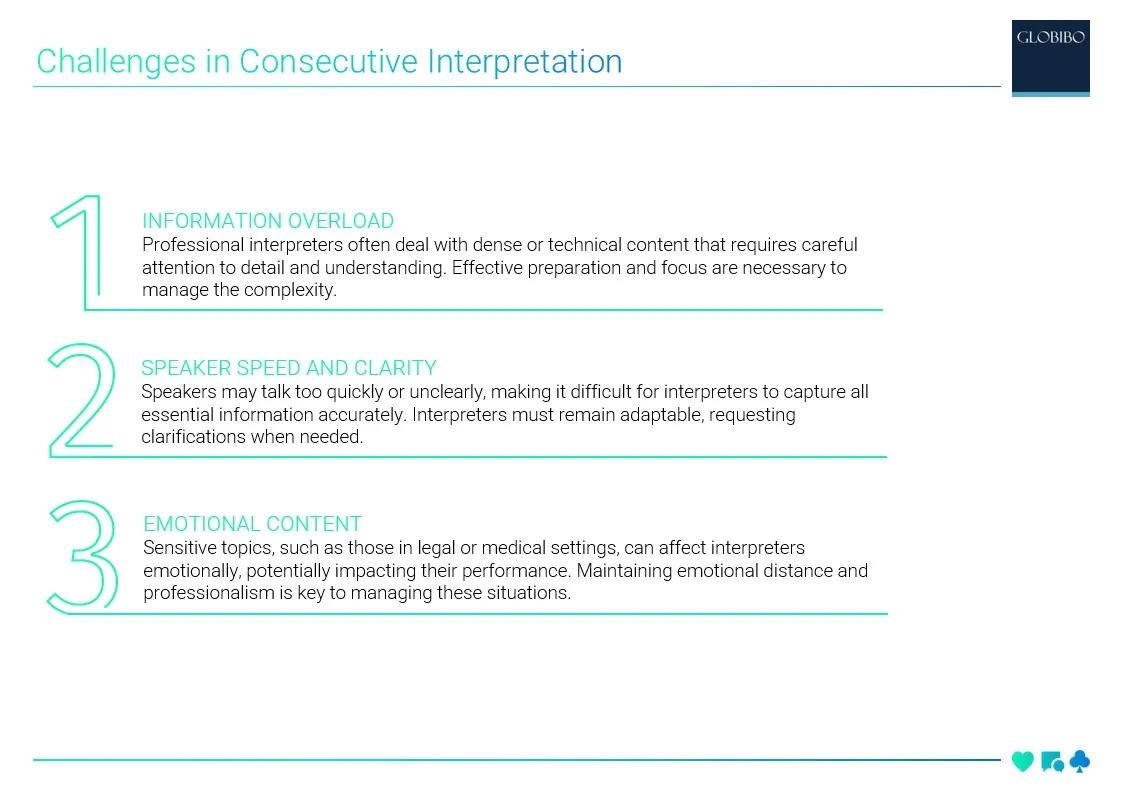
Information Overload
Professional interpreters often deal with dense or technical content.
Solution:
- Break content into smaller segments.
- Use specialized glossaries for industry-specific terms.
Speaker Speed and Clarity
Speakers may speak too quickly or unclearly.
Solution:
- Develop hand signals to request slower speech.
- Use context clues to fill in gaps.
Emotional Content
Sensitive topics can affect interpreters emotionally.
Solution:
- Practice detachment to maintain professionalism.
- Seek support through peer networks when dealing with particularly challenging sessions.
Read more about Challenges Faced by Consecutive Interpreters and How to Overcome Them and Essential Skills Every Consecutive Interpreter Should Master.
Challenges for Consecutive Interpreters & Solutions
Future of Consecutive Interpretation
The growing reliance on multilingual communication in various fields underscores the importance of consecutive interpreters. Advances in technology, such as AI-assisted tools for terminology management and real-time transcription, will likely complement human interpreters rather than replace them. Interpreters who continually refine their skills and adapt to technological trends will remain indispensable.
| Trend | Impact |
| AI and Automation | Tools to enhance accuracy in terminology and reduce preparation time. |
| Increased Globalization | Higher demand for interpreters in cross-border communication. |
| Continuous Learning | Importance of staying updated with linguistic and cultural trends. |
Summary of Consecutive interpreter techniques
Consecutive interpreter play a crucial role in bridging linguistic and cultural gaps, ensuring accurate and effective communication. Mastering techniques such as active listening, structured note-taking, and cultural competence, combined with ongoing training and adaptation to technological advancements, equips interpreters to excel in their field. As global interactions become increasingly complex, the demand for skilled consecutive interpreters will continue to rise, reinforcing their value in fostering understanding across languages and cultures.

Susan has extensive experience in conference interpretation, simultaneous interpretation, and Consecutive Interpretation services, document localization for governmental and legal needs. Her work with embassies and government agencies ensures that documents meet specific regional requirements, making her expertise invaluable for international clients.
YouTube Videos on Consecutive interpreter techniques
Academic reference for Consecutive interpreter techniques
- [PDF] Communication between the speaker and the interpreter in consecutive interpreting
- [PDF] Effective Teaching Strategies of Consecutive Interpreting to Facilitate Cross-Cultural Communication
- Consecutive Interpreting in a Nutshell
- Simultaneous and consecutive interpreting (non-conference settings)
- [PDF] Consecutive Interpretation
- [PDF] Factors influencing the quality of consecutive interpretation from the perspective of interpreter
- Consecutive and simultaneous interpreting
- The Use of the Traditional Tools in Consecutive Interpreting: Advantages and Disadvantages
- Modeling listeners’ perceptions of quality in consecutive interpreting: a case study of a technology interpreting event
- Techniques And Roles Of Consecutive Interpreting In Cultural Exchange Of Foreign Students At Airlangga Global Engament
Key Articles
Mastering Memory: Tips for Aspiring Consecutive Interpreters
How Consecutive Interpreters Simplify Complex Conversations
Your Guide to Success as a Consecutive Interpreter
Leveraging a Global Linguist Network for Superior Consecutive Interpretation Services
Streamlining Consecutive Interpretation in Hybrid Settings with Advanced Technology
Connecting You with Expert Consecutive Interpreters Worldwide
Consecutive Interpreter Tips for Effective Communication
Enhancing Business Outcomes with Consecutive Interpretation
The Role of a Consecutive Interpreter in Multilingual Meetings